If you’ve ever lost a 7075 part to unexpected stress-corrosion cracking at 60% of its ultimate strength, you know the T651 default can be a trap. T7351 trades a small amount of UTS for a far more forgiving SCC rating and double the fracture toughness. This guide gives you the data — KIC, da/dN, SCC threshold, fatigue S-N curves — and the cost premium so you can choose with confidence.
Here is the pattern our engineering team sees again and again in buyer inquiries. A purchasing engineer specifies 7075 plate for a wing rib, a fuselage frame tie, or a military vehicle armor panel. The drawing simply says “7075-T6” or “7075-T651” because that is the temper with the highest published strength and the easiest mill availability. The part passes static proof load with margin to spare. Eighteen months later, a fleet inspection finds intergranular cracks initiating at a fastener hole, and the failure analysis report contains two words nobody wants to read: stress corrosion.
The engineering reality is that 7075-T651 and 7075-T7351 are two different engineering decisions, not two spellings of the same product. T651 is a peak-aged temper stretched to relieve quench residual stress: maximum strength, mediocre fracture toughness, and a short-transverse SCC threshold so low that MIL-HDBK-5 (now MMPDS) advises against sustained tensile stress above roughly 25-35% of yield in the ST direction for T6-type tempers. T7351 is a dual-overaged temper: it deliberately coarsens the precipitate structure, gives up 10-15% of tensile strength, and in exchange roughly doubles KIC, raises the SCC threshold by 2-3×, and slows fatigue crack growth by a factor of two to three in the mid-ΔK regime where most airframe inspection intervals are calculated.
Throughout this comparison, every number is referenced to the governing specifications — AMS 4045 for T651 plate and AMS 4078 for T7351 plate — so you can map the data directly onto your certification basis. For a broader alloy-level primer first, see our 7075 aerospace aluminum complete guide.
Why Damage Tolerance Is Now a Top-3 Spec Requirement
Damage tolerance is no longer a specialist topic reserved for fracture mechanics engineers. Since the 1978 Aloha Airlines accident and the full implementation of FAR 25.571, every transport-category structural submission to the FAA and EASA must demonstrate that the airframe survives with cracks present until they are found by scheduled inspection. The Aircraft Structural Integrity Program (ASIP) used by military airframes imposes the same philosophy: assume a flaw exists at the most critical location, then prove the crack grows slowly enough and residual strength stays high enough between inspections.
For a 7075 structure, that requirement flows straight into the temper choice. A damage-tolerant analysis needs three material inputs: fracture toughness KIC (residual strength of a cracked part), crack growth rate da/dN (how fast a crack extends per flight cycle), and the stress-corrosion threshold (whether environment alone will start cracks at fastener holes). T651 performs weakest on all three inputs. T7351 was specifically developed — first by Alcoa in the late 1960s for the F-4 and later adopted fleet-wide — as the overaged 7075 temper that keeps most of the strength while fixing the SCC and toughness weaknesses.
Practical consequence for buyers: prime contractors increasingly write “T7351 or T7451” into drawings for thick plate because their stress groups cannot close the inspection interval with T651 numbers. If your customer asks for a material substitution justification, the tables in this article are the data you attach. You can also cross-check baseline property values in our aluminum mechanical properties chart.
7075 Temper System Overview
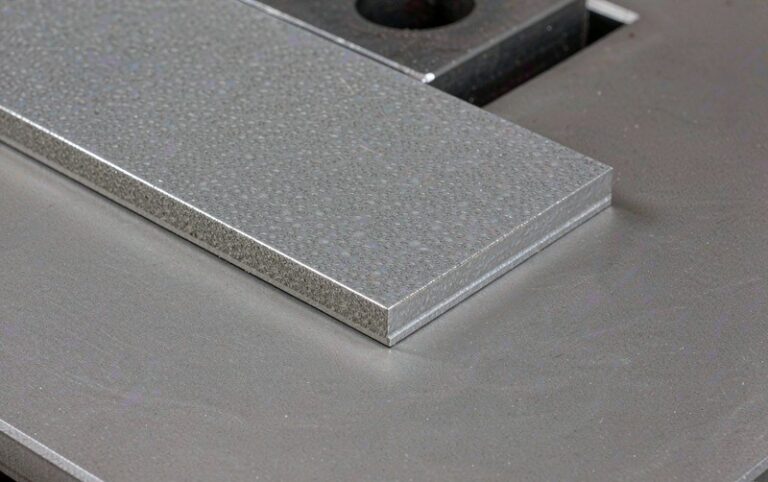
Before comparing two tempers, it pays to understand the full 7075 temper family. The suffix logic tells you the processing story at a glance: T6 is solution treated, quenched, and peak aged; the digit 5 means stress relieved by stretching (1.5-3% permanent set, which flattens quench residual stresses in plate); and the second aging digit (3, 4, 6) indicates how far the temper is overaged beyond peak strength. More overaging means lower strength but progressively better fracture toughness, SCC resistance, and dimensional stability during machining.
| Temper | Condition | Typical Purpose | UTS (MPa) | YS (MPa) | Elong (%) | Hardness (HB) |
|---|---|---|---|---|---|---|
| T6 | Peak aged, no stretch | Maximum strength bar/rod, die forgings | 570-600 | 500-530 | 8-11 | 150-160 |
| T651 | Peak aged + stretched plate | High-strength plate, general structure | 530-560 | 460-490 | 8-11 | 150-160 |
| T73 | Dual overaged (no stretch) | SCC-critical forgings, fittings | 455-505 | 385-425 | 7-11 | 130-140 |
| T7351 | Dual overaged + stretched plate | Damage-tolerant thick plate | 470-500 | 395-425 | 9-12 | 130-140 |
| T7451 | Intermediate overage + stretch | Balanced strength/SCC plate | 490-515 | 415-450 | 8-11 | 135-145 |
| T7651 | Partial overage + stretch | Exfoliation-resistant plate | 515-540 | 440-470 | 8-11 | 140-150 |
Values are typical mid-range for 25-50 mm plate per AMS-QQ-A-250/12 and corresponding AMS specs; always design from MMPDS/CMH-17 A- and B-basis values for certification work. For the alloy chemistry and product forms overview, see the 7075 aerospace aluminum guide, and for how 7075 compares to a weldable 7xxx option, our 7005 vs 7075 comparison.
Mechanical Properties 7075-T7351 vs T651(Plate)
Here is the head-to-head baseline for 25-50 mm plate, the thickness band where most wing and fuselage structure is machined. The strength gap is real but narrower than many buyers expect: T7351 retains roughly 88-90% of T651 ultimate strength and 84-88% of yield.
| Property | 7075-T651 | 7075-T7351 | Delta |
|---|---|---|---|
| Ultimate tensile strength (MPa) | 530-560 | 470-500 | −10 to −12% |
| Yield strength (MPa) | 460-490 | 395-425 | −13 to −15% |
| Elongation (%) | 8-11 | 9-12 | +1 point typical |
| Compressive yield (MPa) | 470-500 | 400-435 | −13 to −15% |
| Hardness (HB) | 150-160 | 130-140 | −15 to −20 pts |
| Density (g/cm³) | 2.81 | 2.81 | No change |
| Elastic modulus (GPa) | 71.7 | 71.7 | No change |
| Spec basis | AMS 4045 | AMS 4078 | — |
Note what does not change: density, modulus, and thermal expansion are temper-invariant, so stiffness- and weight-driven sizing is unaffected. What changes is how much of the cross-section you need to carry limit load — and whether the part tolerates damage once a crack exists. A useful rule of thumb from airframe stress groups: if a T651 design is sized by strength alone, switching to T7351 adds roughly 1-2 kg per 100 kg of machined structure. If it is sized by damage tolerance, T7351 often lets you keep the same gauge because higher KIC compensates for lower yield. For a lower-strength but more formable alternative, see our 6061-T6 deep dive or the 6061 vs 7075 comparison.
Fracture Toughness KIC — Side by Side
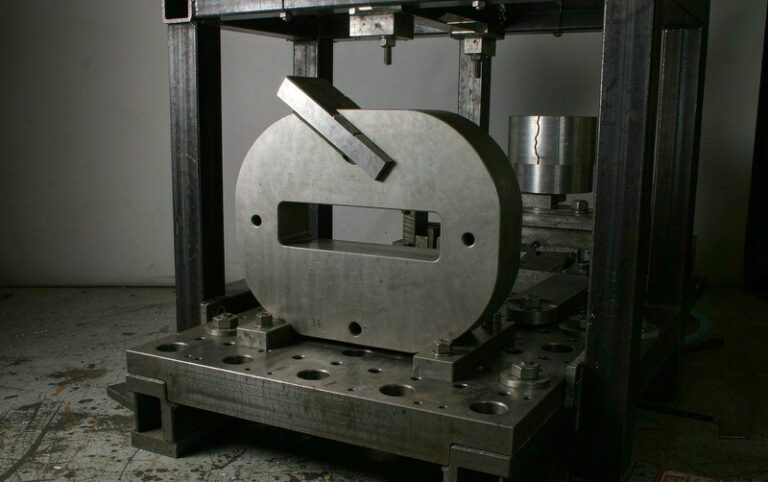
Fracture toughness is where the two tempers truly separate. KIC measures the stress-intensity level at which a pre-existing sharp crack becomes unstable — the higher the value, the longer a crack your part can carry at a given stress without catastrophic failure. Because rolled plate is textured, toughness must be quoted by crack orientation: L-T (crack perpendicular to rolling, loading along it — usually highest), T-L, and S-L (short transverse, always lowest).
| Orientation | 7075-T651 KIC (MPa√m) | 7075-T7351 KIC (MPa√m) | T7351 Advantage |
|---|---|---|---|
| L-T | 29-33 | 36-40 | +20 to +25% |
| T-L | 24-27 | 32-35 | +30 to +35% |
| S-L | 19-22 | 26-29 | +35 to +40% |
Two consequences matter commercially. First, in S-L — the orientation of a delamination-type crack through thick plate, exactly what you worry about at large fastener holes — T7351 carries roughly 35-40% higher toughness. Second, residual strength analysis: for a given crack length, allowable stress scales with KIC, so a T7351 part keeps its required residual strength with a crack 1.5-2× longer. That directly extends inspection intervals, which for an airline operator is worth more per kilogram than any raw-material saving. These same orientation effects are why we always ship plate with rolling direction marked — see the 7075 complete guide for our marking conventions.
Stress Corrosion Cracking Threshold
Stress-corrosion cracking is the failure mode that made overaged 7075 tempers necessary. The classic test is ASTM G47 (3.5% NaCl alternate immersion, 30 days) on short-transverse specimens; the design metric is either the threshold stress (percentage of yield below which no SCC occurs) or the plane-strain threshold stress intensity KISCC for pre-cracked material.
| SCC Metric (ST direction) | 7075-T651 | 7075-T7351 |
|---|---|---|
| ASTM G47 alternate immersion, 30 days | Failures at 25-35% YS | No failure at 75% YS |
| Design SCC threshold (sustained stress) | ~25-35% of YS | ~75% of YS or higher |
| KISCC S-L (MPa√m) | 4-6 | 15-20 |
| Qualitative SCC rating (MMPDS style) | Poor (SCC expected above threshold) | Very high resistance |
| Exfoliation corrosion rating (ASTM G34) | EA-EB (moderate) | EA or better, typically P/EA |
Read the KISCC line carefully: for T651, a crack only 4-6 MPa√m deep in stress-intensity terms can grow by environmental cracking alone — well below its KIC, meaning SCC can propagate subcritically for months before final fracture. T7351 raises that environmental ceiling to 15-20 MPa√m, i.e., 2-3× higher. This is the single most common reason our aerospace customers up-rate legacy T651 drawings to T7351 after a service incident. For environment-driven degradation in marine and industrial atmospheres more broadly, see our aluminum corrosion resistance guide.
💡 7075-T651 in service at >40% YS in humid environments = SCC risk
Short-transverse sustained stresses above roughly 35% of yield — typical at interference-fit fasteners and machined pockets in thick T651 plate — are a documented SCC trigger in humid, coastal, or runway-deicer environments. T7351 raises the no-SCC threshold to about 75% of yield: a 2-3× margin that has made it the default temper for damage-tolerant 7075 plate since the 1970s.
Crack Growth Rate da/dN (Paris Law)
Between initiation and final fracture lives the regime that sets inspection intervals: stable fatigue crack growth, described by the Paris equation da/dN = C(ΔK)m. Lower C and lower m both mean slower crack extension per cycle, which translates directly into more flight hours between NDI inspections. Typical room-air R = 0.1 constants for 25-50 mm plate:
| Paris Parameter (R = 0.1, air) | 7075-T651 | 7075-T7351 |
|---|---|---|
| C (m/cycle, ΔK in MPa√m) | 2.2 × 10⁻¹¹ | 1.6 × 10⁻¹¹ |
| m (exponent) | ≈ 3.4 | ≈ 3.2 |
| da/dN at ΔK = 20 MPa√m | ≈ 0.58 µm/cycle | ≈ 0.23 µm/cycle |
| da/dN at ΔK = 30 MPa√m | ≈ 2.3 µm/cycle | ≈ 0.85 µm/cycle |
In the mid-ΔK band where most transport-wing spectra live, T7351 grows fatigue cracks roughly 2-3× slower. Over a 60,000-flight-hour airframe life, that factor compounds: an inspection interval calculated at 4,000 flights with T651 data stretches to 8,000-10,000 flights with T7351 data, halving lifetime NDI cost. In corrosive media (3.5% NaCl, sump water) the T651 penalty grows further because environment-assisted growth stacks on top of mechanical growth — another reason T7351 dominates naval and carrier-based applications.
Fatigue Endurance Limit (S-N Curves)
S-N behavior adds a nuance buyers often miss: on smooth, unnotched specimens tested in dry air, T651 actually holds a small edge because higher strength delays slip-band initiation. But real parts are not smooth specimens — they have holes, fillets, and faying surfaces, and in notched or corrosive conditions the ranking flips because early crack growth, not initiation, dominates life.
| Fatigue Condition (axial, R = 0.1) | 7075-T651 | 7075-T7351 |
|---|---|---|
| Smooth specimen, 5 × 10⁸ cycles, air (MPa) | 155-170 | 145-160 |
| Notched (Kt = 3), 107 cycles, air (MPa) | 85-95 | 90-100 |
| Notched, 107 cycles, 3.5% NaCl spray (MPa) | 55-70 | 80-95 |
| Small-crack growth life (to 1 mm, typical spectrum) | Baseline | 1.5-2.5× longer |
The bottom row is the buyer-relevant summary: in notched, wet service — the definition of an airframe joint — T7351 delivers longer total fatigue life despite lower strength. When your design authority asks “is the strength loss acceptable?”, this table is the answer.
Heat Treatment Path: T651 → T7351
Both tempers share the same front end: solution treatment at 465-480°C, cold-water (or polymer) quench, then a controlled mechanical stretch of 1.5-3% permanent set to relieve quench stress — the “51” suffix. The divergence is entirely in artificial aging:
- T651: single-stage age at ~120°C for ~24 h. Precipitates peak to maximum coherent GP-zone and η′ density — maximum strength, but a microstructure that is electrochemically active along grain boundaries, which is precisely why SCC susceptibility is worst at peak age.
- T7351: dual-stage overage — first ~8-12 h at 120°C (nucleation), then 8-16 h at ~165-175°C (coarsening). The η precipitates grow into a spaced, semi-coherent array; strength drops 10-15%, but grain-boundary precipitate spacing increases, making hydrogen-assisted intergranular cracking far harder to sustain.
Practical sourcing notes: T7351 requires roughly 24 extra furnace hours versus T651, and the second aging stage consumes furnace capacity that high-volume mills would rather fill with T6 product — both feed the price premium discussed below. Can finished T651 plate be re-aged to T73? In theory yes (re-solution treat and re-age), but re-solutionizing thick plate adds oxide, distortion and grain-coarsening risk, and the re-processed material cannot be certified to AMS 4078 as prime. Treat re-tempering as a repair-path curiosity, not a supply strategy.
Cost Premium: T7351 vs T651 in 2026
Indicative 2026 FOB China mill-direct pricing for certified aerospace plate (AS9100 mill, EN 10204 3.1 cert, per metric ton, standard export packaging):
| Cost Element (2026, FOB) | 7075-T651 | 7075-T7351 | Premium |
|---|---|---|---|
| Plate 12-50 mm, $/kg (MOQ 1-3 t) | 5.8-6.8 | 6.8-8.2 | +15 to +25% |
| Plate 50-100 mm, $/kg | 6.5-7.6 | 7.6-9.0 | +15 to +22% |
| Mill lead time (prime cert) | 15-20 days (stock) | 20-25 days (stock/custom) | +5 days typical |
| Minimum order quantity | 1 t (HXM stock program) | 1 t (HXM stock program) | None |
| Certification package | EN 10204 3.1 incl. | EN 10204 3.1 incl. | None |
Premium drivers: extra aging furnace time, lower total market volume (fewer mills run AMS 4078), and slower inventory turn for distributors. Against that, factor in life-cycle savings: one avoided SCC teardown investigation on a fleet of wing panels typically costs more than the entire raw-material premium on the batch. Our view after supplying both tempers for years: if the part sees sustained tension in the short-transverse direction, humid service, or a damage-tolerance-based inspection plan, the T7351 premium pays for itself.
Need T7351 plate to spec?
HXM stocks 7075-T7351 in 12-100 mm thickness with EN 10204 3.1 certification, AS9100-aligned QC, and MOQ from 1 ton. Send your drawing for a same-day quote.
Forming & Machinability
Neither temper is a forming alloy. In plate gauges both are limited to gentle cold forming — minimum bend radii of 9-12× thickness for T651 and 7-9× for T7351 in the softest orientations, and hot forming above 200°C is prohibited after final aging because it overages the temper and voids the cert. If your part needs significant forming, the answer is not a 7075 temper change but a different product route: form in annealed or O/F condition, machine, then age to final temper — the classic forged-fitting path. For genuinely form-heavy structural parts, review our 6061 sheet and plate range or 6061-T6 property guide.
Machinability is a genuine 7075 strength and the T7351 news is good: most shops report A-rating machinability for both tempers, with T7351 marginally better chip breaking and lower built-up edge because the overaged structure is slightly less gummy. More importantly for thick plate, the stretched condition plus overaging means better dimensional stability during heavy metal removal — less residual-stress redistribution distortion when you pocket a 70 mm plate down to a monolithic rib. Our machining customers machining 80% of stock away consistently report 20-30% less post-machining distortion on T7351 versus T651. Dust control, carbide geometry, and flood coolant recommendations are identical to the general 7075 machining practice we document separately.
Anodizing & Surface Finishing
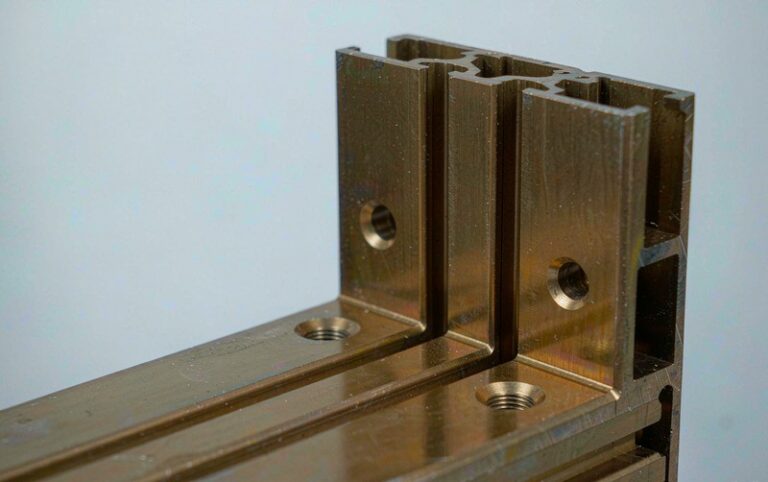
Both tempers anodize well with one critical caveat inherited from the alloy, not the temper: 7075’s Cu and Zn content produces a slightly grey, less-abrasive-resistant oxide than 6061, and thin chromic/boric-sulfuric anodize films (used where fatigue penalties must be minimized) require tight process control. Temper-specific notes:
- T651: accepts Type II and Type III films normally, but sealed hardcoat on a high-residual-stress temper can add crack-initiation sites at sharp edges — shot-peen or radius before anodizing fatigue-critical features.
- T7351: identical film formation, and its higher KIC makes the (necessarily micro-cracked) hardcoat layer less consequential for fatigue. Many armor and naval programs specify T7351 + Type III hardcoat precisely for this combination.
Beware the classic trap: re-aging during any high-temperature coating cure. Powder-coat cure at 180°C for 20 minutes roughly reproduces the second T73 aging stage — harmless for T7351, but it overages T651 and silently drops its yield strength by 5-10%. Full process detail is in our aluminum anodizing complete guide.
Welding: Neither Temper Is Weldable by Fusion
This section is short because the answer is absolute: 7075 in any temper is not fusion weldable for structural use. The Cu + Zn combination drives hot cracking in the weld pool, and any weld heat input annihilates the aged microstructure in the HAZ — you locally reset the temper to something weaker than annealed, with no practical way to restore it on a finished assembly. Friction stir welding (FSW) is the accepted exception: solid-state, no melting, and FSW joints in 7075-T7351 plate show fatigue performance that supports damage-tolerant panel designs; several fuselage and launcher programs use it successfully.
If your design concept involves fusion welding, change the alloy, not the temper — 7005 is weldable and we compare the trade-offs in 7005 vs 7075, or see our 7005 tube range for welded tube structures. Mechanical fastening (Hi-Lite, lockbolts) and adhesive bonding remain the standard joining routes for 7075 structure in both tempers.
Aerospace Applications Map
The table below condenses everything above into a part-by-part selection guide drawn from what our customers actually order:
| Part Type | Recommended Temper | Deciding Factor |
|---|---|---|
| Wing spar caps / chord members | T7351 (T7451 alt.) | Sustained tension + DT-based inspection interval |
| Fuselage frames & bulkhead webs | T7351 | Crack growth life between C-checks |
| Wing ribs (pocketed plate) | T651 or T7351 | Compression-dominated: T651 OK if low sustained ST stress |
| Landing gear / gear-support fittings | T73 forging or T7351 plate | SCC at press-fit bushings, impact toughness |
| Engine pylon fittings | T7351 | Thermal + sustained load, high K_IC requirement |
| Cargo floor rails & seat tracks | T651 | High static loads, replaceable items, low SCC exposure |
| Control-surface hinges | T651 | Low mass, low sustained stress, easy inspection |
| Helicopter dynamic components | T73/T7351 | High-cycle fatigue, corrosion exposure |
| UAV wing structure | T651 | Short airframe life, weight-critical, low corrosion duty |
Notice the pattern: the closer a part sits to the primary load path of a long-life, long-inspection-interval airframe, the stronger the case for T7351. Secondary structure and short-life airframes can justify T651 economics.
Defense / Armor Plate Applications
Military ground vehicles and naval craft adopted overaged 7075 for the same reasons aviation did, plus two more. First, blast and ballistic loading is the ultimate damage-tolerance event: a T7351 armor spall plate with 35-40% higher S-L toughness resists through-crack propagation and delamination during multi-hit events measurably better than peak-aged plate. Second, combined environmental exposure — salt spray, fuel, deicing fluids — makes the 2-3× SCC threshold margin not a nicety but a survivability requirement for hull-adjacent panels that cannot be inspected every year.
Typical defense uses in our shipment mix: mine-resistant vehicle floor and side-wall backing plates (20-60 mm T7351), naval superstructure brackets, launcher rail and canister components, and ordnance fuze housings. Procurement teams on these programs usually specify MIL-A-22771 lineage or AMS 4078 plus full traceability, which we cover next. Where weight per protection is dominant and multi-hit toughness matters less, some vehicle programs still select T651 or move to 5083-type alloy — the corrosion trade-offs are covered in our corrosion resistance guide.
AS9100 + AMS-QQ-A-250/12 + AMS-4045 + AMS-4078
The specification stack for certified 7075 plate is compact, and knowing which document governs which property lets you audit a mill cert in minutes:
- AMS-QQ-A-250/12 — the umbrella plate specification for 7075 (successor to MIL-A-22771 for plate): chemical limits, tempers offered, dimensional tolerances, and QC requirements.
- AMS 4045 — 7075-T651 plate, with minimum tensile properties by thickness range. Your T651 cert must show UTS/YS/elongation meeting these minima, per heat and per thickness lot.
- AMS 4078 — 7075-T7351 plate, the equivalent governing spec for the overaged temper. If a supplier offers “T73 plate” without AMS 4078 conformance, it is not certifiable material for aerospace prime structure.
- ASTM B646 / G47 / G64 — fracture-toughness test practice and SCC ratings underlying the tables above.
- EN 10204 3.1 — the inspection document standard: certified test results from the actual lot, validated by the manufacturer’s independent QC unit. This is our default cert package on every 7075 shipment, AS9100-aligned quality system throughout.
One purchasing trap: “MIL-A-22771 compliant” language in quotes. The MIL spec was cancelled and replaced by AMS-QQ-A-250/12; a current cert should reference the AMS document. Older drawings can be updated by the revision note route without re-qualification in most programs.
Buyer Checklist: How to Verify the Temper You Receive
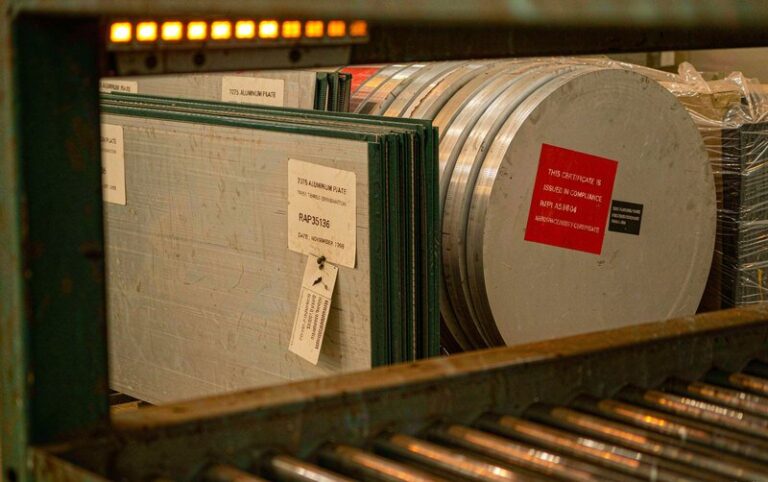
T651 and T7351 plate look identical; only documentation and a hardness check can tell them apart. Before you accept the shipment:
- Check the temper on the plate marking — stencil must read 7075-T7351 (or T651), with heat number traceable to the cert.
- Match the cert spec to the temper — AMS 4045 = T651, AMS 4078 = T7351. A “T73” stamp on a cert citing AMS 4045 is a red flag.
- Verify tensile values — if UTS reads 540-560 MPa on a T7351 cert, something is wrong; T7351 tests around 470-500 MPa.
- Spot-check hardness — HB 150-160 indicates peak-aged material; HB 130-140 indicates overaged. A 2-minute Brinell check catches the most common mix-up (T651 delivered against a T7351 PO).
- Confirm stretch records — the “51” requires 1.5-3% permanent set; ask for the stretching log if heavy machining distortion has bitten you before.
- Confirm EN 10204 3.1 (not 2.2) — 3.1 means actual lot test results validated by the mill’s independent QC; 2.2 is a non-specific declaration and will fail aerospace receiving inspection.
- Orientation marking — rolling direction arrows on plate let your machinist orient critical features relative to L, T, and S directions as the drawing requires.
Common Mistakes When Specifying 7075
⚠️ Buyer Pain: My T651 part is cracking at 60% of UTS — what’s wrong?
✅ HXM Solution: Classic short-transverse SCC at a sustained-stress feature (press-fit bushing, interference fastener, deep pocket corner). The fix is a temper change to T7351, reducing sustained ST stress below 35% YS, or both — not a thicker T651 part, which raises the sustained stress it must carry.
⚠️ Buyer Pain: Copying ‘7075-T6’ from a legacy drawing onto thick plate.
✅ HXM Solution: T6 does not exist as a certified plate temper — plate is stretched, so it is T651 (peak aged) or T73xx (overaged). Ask us to review legacy T6 references; we map them to T651 or T7351 based on the part’s duty in one pass.
⚠️ Buyer Pain: Buying T7351 for compression-dominated replaceable structure.
✅ HXM Solution: Overaging costs 10-15% strength with no SCC or DT benefit in low-sustained-stress compression members. T651 is the correct economic choice there — we stock both and will tell you when the cheaper temper is right.
⚠️ Buyer Pain: Re-aging or high-temperature coating a T651 part unknowingly.
✅ HXM Solution: A powder-coat cure at 180°C can silently overage T651 and drop yield strength 5-10%. Keep post-machining thermal exposure under 120°C for T651; T7351 tolerates its own aging temperatures and is far more forgiving.
T7351 vs T7451 vs T7651 — Quick Differentiation
Buyers frequently ask which overaged temper to choose. All three are stretched plate; the difference is how far past peak age the mill stops:
| Attribute | T7351 | T7451 | T7651 |
|---|---|---|---|
| Aging extent | Full dual overage | Intermediate overage | Light/partial overage |
| UTS relative to T651 | −10 to −12% | −7 to −9% | −3 to −5% |
| SCC resistance | Highest | High | Moderate |
| Exfoliation resistance | High | High | Highest (its design goal) |
| Best use | Max damage tolerance & SCC margin | Balanced strength + SCC | Atmospheric exfoliation-critical skins |
| Governing AMS (plate) | AMS 4078 | AMS 4079 (T7451) | AMS 4070 family |
Rule of thumb: T7351 when SCC and toughness govern, T7651 when exfoliation of thin external skins governs, T7451 when you need to claw back strength while keeping most of the T73 SCC margin. HXM’s stock program is weighted toward T7351 because that is what damage-tolerant structure asks for; the others are quote-to-spec items.
Get the Data Pack Before You Order
Comparing tempers for a live RFQ? Send us the part drawing and load spectrum, and our engineering desk will return a temper recommendation with the applicable AMS basis, current pricing for 12-100 mm plate, and lead-time options — usually within one business day. Every shipment ships with EN 10204 3.1 certification and full heat traceability.
7075-T7351 vs 7075-T651: Frequently Asked Questions
What is the difference between T7351 and T651?
T651 is peak-aged 7075 plate stretched for stress relief — maximum strength but modest fracture toughness and poor short-transverse SCC resistance. T7351 is dual overaged and stretched: it gives up 10-15% of tensile strength in exchange for roughly 20-40% higher K_IC, a 2-3× higher SCC threshold, and 2-3× slower fatigue crack growth. Use T651 for static-loaded structure; use T7351 where damage tolerance, inspection intervals, or corrosive environments matter.
Is 7075-T7351 stronger than T651?
No — in conventional tensile terms T651 is stronger, typically 530-560 MPa UTS versus 470-500 MPa for T7351 in 25-50 mm plate. But ‘strength’ in a cracked structure is measured by K_IC, and there T7351 wins by 20-40% depending on orientation. If your part must carry a known crack between inspections, T7351 is effectively the stronger temper.
What is the SCC threshold for 7075-T7351?
In ASTM G47 alternate-immersion testing (3.5% NaCl, 30 days, short-transverse), T7351 shows no failure at stresses up to about 75% of yield strength, versus failures for T651 at 25-35% of yield. Its plane-strain K_ISCC in the S-L orientation is roughly 15-20 MPa√m versus 4-6 MPa√m for T651 — a 2-3× improvement in the environmental cracking ceiling.
Why is T7351 more expensive than T651?
Three reasons: the dual aging cycle adds roughly a day of extra furnace time per lot; fewer mills worldwide maintain AMS 4078 qualification, so supply is thinner; and distributor inventory turns more slowly. The typical premium is 15-25% per kilogram FOB, which is usually small next to the life-cycle cost of a single SCC event.
Can 7075-T651 be re-heat-treated to T7351?
Technically you can re-solution-treat and re-age T651 plate to a T73-type condition, but re-solutionizing thick plate risks oxidation, distortion, and grain growth, and the re-processed material cannot be certified as prime AMS 4078. For certified aerospace structure, buy T7351 in the required condition rather than converting stock.
Does 7075-T7351 meet MIL-A-22771?
MIL-A-22771 was cancelled and superseded by AMS-QQ-A-250/12, which covers 7075 plate in both tempers, with AMS 4078 providing the detailed T7351 requirements. Material produced and certified to AMS 4078 satisfies the intent of the old MIL spec; current drawings should reference the AMS documents.
Which 7075 temper is best for aircraft wing spars?
For spar caps and chord members in damage-tolerant transport-category wings, T7351 (or T7451) is the preferred plate temper: sustained tensile stress plus long inspection intervals demand high K_IC and slow da/dN, which the overaged tempers provide. T651 remains acceptable for compression-dominated, easily inspectable secondary structure.
What is the fracture toughness K_IC of 7075-T7351?
Typical values for 25-50 mm plate are 36-40 MPa√m in L-T, 32-35 in T-L, and 26-29 in S-L orientation. Comparable T651 values are 29-33, 24-27, and 19-22 MPa√m respectively. Always design from MMPDS/CMH-17 A- or B-basis values for the specific thickness and orientation rather than typical values.
Is 7075-T7351 weldable?
No. Like all 7075 tempers, it is not fusion weldable for structural use — the Cu/Zn chemistry causes hot cracking and the weld heat destroys the aged microstructure. Friction stir welding is the accepted solid-state exception and performs well on T7351 plate. Otherwise join by mechanical fastening or bonding.
What thicknesses are available for 7075-T7351 plate?
HXM stocks 7075-T7351 plate from 12 mm to 100 mm, in standard mill widths and lengths, with cut-to-size service from our stock program. Minimum order quantity is 1-3 tonnes depending on thickness, and lead time is typically 15-25 days for certified material with EN 10204 3.1 documentation.
How much does 7075-T7351 cost per kg in 2026?
Indicative 2026 FOB pricing is USD 6.8-8.2 per kg for 12-50 mm plate and USD 7.6-9.0 for 50-100 mm, against 5.8-6.8 and 6.5-7.6 for T651 — a 15-25% premium. LME aluminum moves these bands, so request a current quote with your thickness and quantity.
Does HXM supply 7075-T7351?
Yes. HXM Aluminum supplies 7075-T7351 plate in 12-100 mm thickness from an AS9100-aligned quality system, EN 10204 3.1 certification with every lot, full heat traceability, and MOQ from 1 tonne. Send your drawing or RFQ to our engineering desk for a same-day quote.
The Bottom Line
If your 7075 part lives on the primary load path, sees sustained tension in the short-transverse direction, or is inspected on a damage-tolerance schedule, specify T7351 — the 10-15% strength concession buys double the fracture toughness, a 2-3× SCC threshold, and half the crack growth rate. If your part is compression-dominated, easily inspected, and cost-sensitive, T651 remains the correct choice. The expensive mistake is choosing by default instead of by duty.
Related reading to complete your material selection: the 7075 aerospace aluminum complete guide for chemistry, forms and specifications; 6061 vs 7075 and 7005 vs 7075 for alloy-level alternatives; 2024 aluminum for aerospace for fatigue-driven fuselage skins; and the aluminum mechanical properties chart for cross-alloy benchmarking. For finishing routes, see the anodizing guide and corrosion resistance guide; for a weldable 7xxx option, our 7005 tube products.
Related Articles
- 7075 Aerospace Aluminum: The Complete Guide
- 6061 Aluminum vs 7075 Aluminum: Which Alloy to Choose
- 7005 vs 7075 Aluminum: Aerospace and Sports Applications
- 2024 Aluminum for Aerospace Applications
- A Deep Dive Into 6061-T6 Aluminum: Properties, Heat Treatment, Uses
- Aluminum Mechanical Properties Chart: All Alloys Compared
- Aluminum Anodizing: The Complete Guide
- Aluminum Corrosion Resistance Guide
Specify with confidence. Order 7075-T7351 or T651 plate from HXM.
12-100 mm certified plate, EN 10204 3.1, AS9100-aligned QC, MOQ 1-3 t, 15-25 day lead time. Engineering support on every temper decision.