5052 Aluminum Plate: 16 Buyer Questions Answered
If you are sourcing 5052 aluminum plate — for a boat hull, fuel tank, truck body, pressure vessel or architectural project — you probably have the same questions every buyer asks before placing an order: What density do I use for weight calculation? Is it really marine grade? Can it be welded and bent? How does it compare with 6061 or 5083? What are the MOQ, lead time and certifications?
This guide answers the 16 most-asked 5052 aluminum plate questions, with the same data our engineers use when quoting. For full thickness, tolerance and cutting specifications, see the 5052 aluminum sheets & plates product page or the 5052 alloy overview.
Frequently Asked Questions About 5052 Aluminum Plate
What is the density of 5052 aluminum plate?
5052 aluminum has a density of 2.68 g/cm³ (0.0968 lb/in³). This is about one-third lighter than steel, which is why 5052 plate is a first choice for boat hulls, truck bodies and other weight-sensitive structures. Because plate is priced per tonne, the density also matters for buyers: 1 m³ of 5052 plate weighs 2,680 kg. Need an exact weight for a given size? Use our sheet and plate thickness list on the 5052 aluminum sheets page.
What is 5052 aluminum plate?
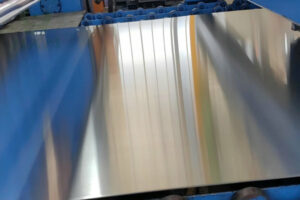
5052 is an aluminum-magnesium alloy (AlMg2.5) in the 5xxx series. It is a non-heat-treatable alloy: strength is developed by cold working (O, H32, H34, H36, H38 and H112 tempers) rather than by aging. Its 2.5% magnesium content gives excellent corrosion resistance, especially in saltwater, while keeping good formability and weldability. It is one of the most widely stocked marine-grade aluminum plates in the world, supplied as flat plate in thicknesses above 6 mm (1/4 in).
What are the tempers and mechanical properties of 5052 aluminum plate?
Standard tempers per ASTM B209 are O, H32, H34, H36, H38 and H112. Typical mechanical properties:
| Temper | UTS (MPa) | Yield (MPa) | Elongation % |
|---|---|---|---|
| O | 170–215 | ≥65 | ≥19 |
| H32 | 210–260 | ≥160 | ≥12 |
| H34 | 235–285 | ≥180 | ≥10 |
| H36 | 255–305 | ≥200 | ≥8 |
| H38 | 270–320 | ≥220 | ≥6 |
| H112 | 170–215 | ≥65 | ≥14 |
H32 and H34 are the most common tempers for general fabrication; H112 suits thick plate used in as-fabricated marine structures.
Is 5052 aluminum plate suitable for marine and saltwater use?
Yes — 5052 is one of the best alloys for saltwater exposure. The magnesium-rich passive oxide film self-heals after scratches, so it resists pitting and intergranular corrosion far better than 6061 or steel. For boat hulls, decks and offshore structures, H116 and H321 tempers are the classification-society-approved marine grades (Lloyd’s, DNV, ABS). HXM Aluminum supplies 5052 H116/H321 plate with full mill test certificates. See the 5052 alloy hub page for the full product family.
Can 5052 aluminum plate be welded?
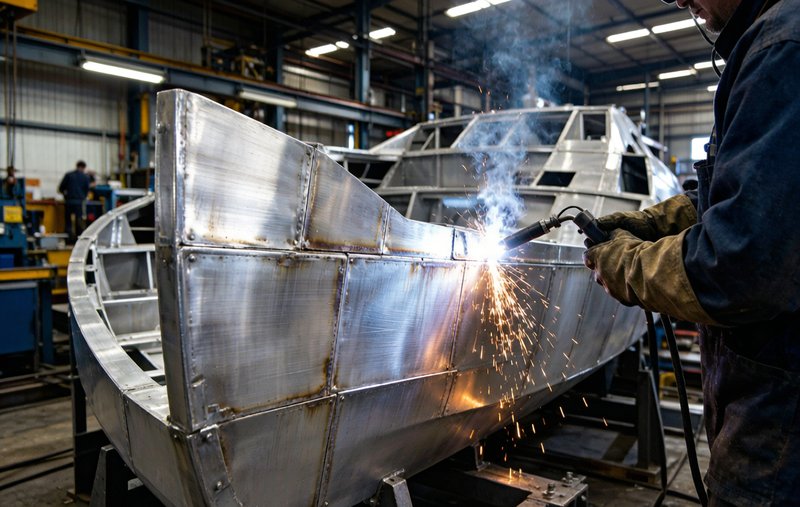
Yes. 5052 has excellent weldability by TIG and MIG processes, noticeably better than 6061 because it does not hot-crack as easily. Recommended filler is ER5356 or ER5556. The as-welded joint retains good corrosion resistance, which is why shipyards weld 5052 hulls and tanks without post-weld heat treatment. If your project involves welded assemblies, state the welding process and filler when requesting a quote so we can confirm the correct temper and thickness.
Can 5052 aluminum plate be bent or formed?
Yes. 5052 is among the most formable 5xxx alloys and is widely press-braked, rolled and stamped. As a rule of thumb for a 90° bend: minimum inside radius ≈ 1.0–2.0× thickness for O-temper, 2.0–3.0× for H32/H34, and larger for H36/H38. Bending causes local work-hardening, so finished parts are often stronger than the raw plate. For tight-radius or heavy-gauge bends we recommend specifying the alloy temper and bend direction (longitudinal vs transverse) on the drawing.
What is the difference between 5052 aluminum sheet and plate?
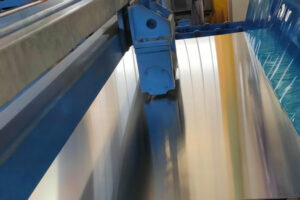
The boundary is defined by thickness. Under ASTM B209, plate is over 6.35 mm (0.250 in) thick; sheet is 6.35 mm and thinner. In metric practice (EN 485), the dividing line is usually 6 mm. So a 3 mm 5052 blank is ‘sheet’, while 8 mm and 12 mm 5052 are ‘plate’. Processing also differs: plate is typically sawed or laser-cut, while sheet is sheared and formed. We stock and process both — compare thickness, tolerance and cutting options on the 5052 sheets & plates page.
What is the difference between 5052 and 6061 aluminum plate?
The two alloys suit different jobs:
| Property | 5052 | 6061 (T6) |
|---|---|---|
| Heat treatable | No | Yes |
| Typical UTS | 210–260 MPa (H32) | ~290 MPa |
| Saltwater corrosion | Excellent | Moderate |
| Formability / bending | Excellent | Good |
| Weldability | Excellent | Good (crack-prone) |
| Machining | Fair | Good |
Choose 5052 for marine, tanks, fuel and general fabrication; choose 6061 when higher strength after heat treatment or better machinability is the priority.
What is the difference between 5052 and 5083 aluminum plate?
Both are marine 5xxx alloys, but 5083 is the higher-strength, higher-cost option. 5083 (AlMg4.5Mn0.7) in H116 temper reaches UTS 275–350 MPa and is specified for large ship hulls, LNG tank supports and cryogenic service. 5052 (AlMg2.5) tops out around 320 MPa in H38, is easier to form and bend, and costs less per tonne. For small craft, tanks, architectural panels and general fabrication, 5052 usually delivers the best value; for heavy marine structures under classification, 5083 is the common choice.
What sizes are available for 5052 aluminum plate?
Common stocked sizes include 4’×8′ (1220×2440 mm), 4’×10′ (1220×3050 mm), 5’×10′ (1500×3000 mm), 1500×6000 mm and 2000×6000 mm, in thicknesses from 6 mm up to 120 mm. Custom cutting (laser, saw, shear) to your exact dimensions is available, including machined blanks and drilled/routed parts. Tell us your required thickness, width, length and quantity — we will confirm stock or mill production within one working day.
Does 5052 aluminum plate rust?
No. 5052 contains no iron, so it cannot form iron oxide (rust). The natural aluminum oxide film protects the surface and regenerates after cutting or scratching. Two practical cautions: (1) avoid long-term contact with steel fasteners or supports in wet conditions — galvanic corrosion can attack the aluminum at the junction; (2) in severe marine service, H116/H321 tempers with their stabilized grain structure give the best long-term performance.
Can 5052 aluminum plate be anodized?
Yes, but 5052 is not the easiest alloy to anodize. Magnesium in the alloy slows oxide growth and can leave a hazy finish, so the anodizer must adjust the electrolyte and current density. If you need a decorative or protective anodized coating, 6xxx alloys such as 6061 give more uniform results. If anodizing is a must-have for a 5052 part, order a sample first and qualify the finish with your anodizer before full production.
How much does 5052 aluminum plate cost?
5052 plate is priced per kilogram or per tonne and tracks the London Metal Exchange (LME) aluminum price plus a conversion premium that depends on temper, thickness, dimensions and quantity. As a reference, export FOB prices for 5052 H32 plate are typically in the range of USD 2,400–3,200 per tonne depending on size and order volume — this moves with the market, so treat it as a guide, not a quote. For an exact price, send your specification (alloy, temper, thickness, size, quantity, destination port) to our sales team.
What is the MOQ and lead time for 5052 aluminum plate?
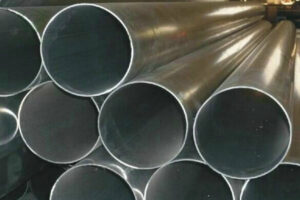
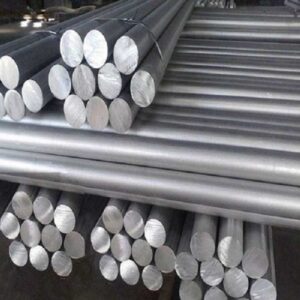
Typical MOQ is 1–3 tonnes per size; smaller trial orders and samples are available on request. Lead time: stocked sizes ship in 3–7 days; mill production for non-stock sizes takes 15–25 days. Sea freight from our port to Europe or North America adds roughly 30–45 days depending on the destination. We disclose MOQ, lead time and payment terms clearly before you place an order — no hidden surprises. See our 5052 bars, coils, strips and tubes for the same transparent policy across the 5052 family.
What certifications come with 5052 aluminum plate?
Every shipment includes a Mill Test Certificate (MTC) per EN 10204 3.1 showing the actual chemical composition and mechanical test results of the delivered lot. HXM Aluminum operates an ISO 9001 quality system, and marine-grade H116/H321 plate can be supplied with classification society certificates (DNV, ABS, LR) when required. For pressure-vessel or other regulated applications, confirm the standard and certification requirement with us before production so the correct documentation is prepared.
Do you offer cutting and custom processing for 5052 plate?
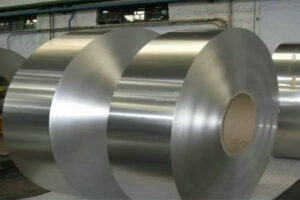
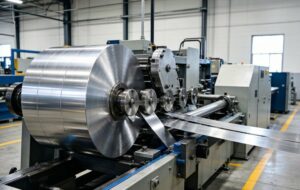
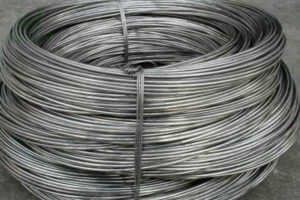
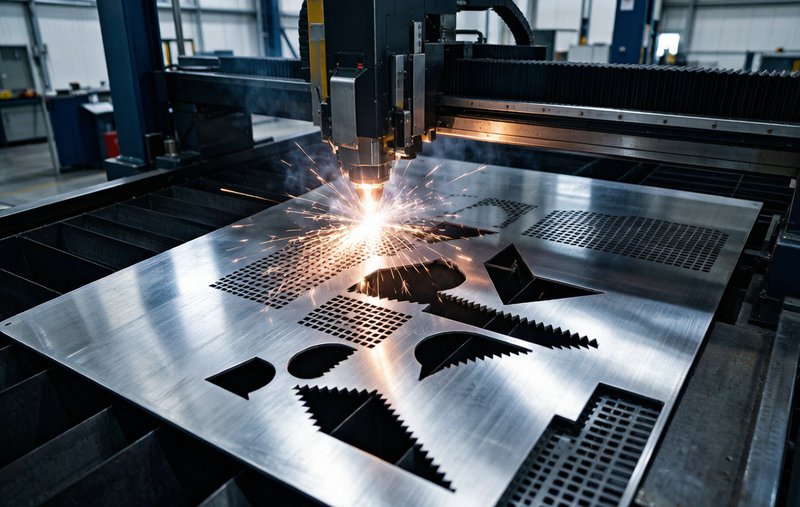
Yes. We provide laser cutting, shearing, sawing, drilling, routing, deburring and edge conditioning for 5052 plate, plus supply of slit coils and strip for downstream stamping. You can order cut-to-size blanks with a tolerance of ±0.5 mm for laser work. Send us a drawing (DXF/PDF) with alloy, temper and quantity and we will confirm pricing and lead time within one working day. Start with the 5052 sheets & plates product page to review available thickness and tolerance data.
Get a Quote for 5052 Aluminum Plate
Did not find your answer? Send us your specification — alloy, temper, thickness, dimensions, quantity and destination port — and our engineers will reply with pricing, MOQ and lead time within one working day. No minimum-order pressure for trial quantities, and the Mill Test Certificate is included with every delivery.
Related reading: 5052 aluminum alloy properties & tempers · 5052 sheets & plates · 5052 coils · 5052 strips · 5052 tubes · 5052 bars