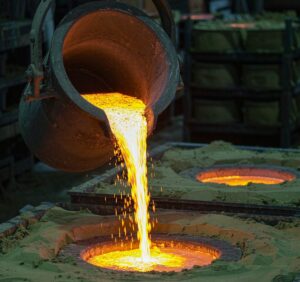
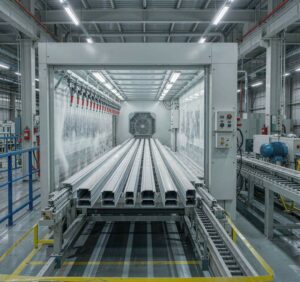
Your 40ft high-cube container has 26–28 metric tons of payload capacity. But coil aluminum hits 22–26 t of payload per 40ft, sheet hits 23–26 t, bar 24–27 t, and tube 18–22 t — depending on coil OD, sheet thickness, bar length, and the dunnage you use. Get the loading wrong and you are paying $50–150/t of dead freight for air you shipped across an ocean.
This guide gives you form-specific loading data: 20ft vs 40ft vs 40ft HC payloads for coil, sheet, plate, bar, rod, tube, and foil. It covers dunnage specifications (wood, steel, cardboard), weight distribution rules, anti-rust protection, VCI paper, LCL break-even thresholds, Incoterms 2020 loading responsibility, and a container-loading inspection checklist. Whether you are sourcing 5052 coil, 6061 sheet, 6061 bar, or household foil, the loading rules below apply.
As a B2B aluminum manufacturer and exporter, HXM Aluminum loads coil, sheet, bar, tube, and foil every week into 20ft and 40ft containers from our China mills. Our logistics team calculates the optimal packing plan for each shipment — dunnage type, weight distribution, bracing pattern — so you receive the right tonnage at the lowest landed cost.
Why Container Loading Optimization Matters for Aluminum Buyers
For most international aluminum buyers, ocean freight is the second-largest line item on the landed-cost sheet — after the alloy premium. Container loading mistakes quietly add 5–20% to that freight bill, and the buyer pays them. Three forces make this guide worth your time:
1. Freight cost as a percentage of landed cost. On a typical 20–30 t shipment of 5052 coil shipped from China to the US East Coast, ocean freight runs $80–180/t and inland drayage $30–60/t. If your loader “loosily” loads only 22 t into a 40ft that should hold 26 t, you just paid for 4 t of air at $110–240/t = $440–960 of dead freight, plus extra per-container fixed costs. On a 50 t order split across two 40fts, that adds up fast.
2. Container availability and rolling equipment. Post-2024 container shortages and Red Sea diversions have pushed 40ft container spot prices to $3,500–20+ per TEU-equivalent on some lanes. Maximizing payload per container is no longer optional — it is the difference between a viable margin and a margin loss.
3. ESG and Scope-3 emissions. Every TEU of freight represents roughly 1.5–2.5 t of CO₂ equivalent on transoceanic lanes. Loading aluminum more densely — hitting 26 t instead of 22 t in a 40ft — directly reduces your Scope-3 transport emissions per ton of aluminum delivered. Many procurement teams now include “tons per TEU” in their supplier scorecards.
If you are new to aluminum sourcing, read our China sourcing guide first to understand the full landed-cost math.
Container Basics for Aluminum: 20ft, 40ft, 40ft HC Specifications
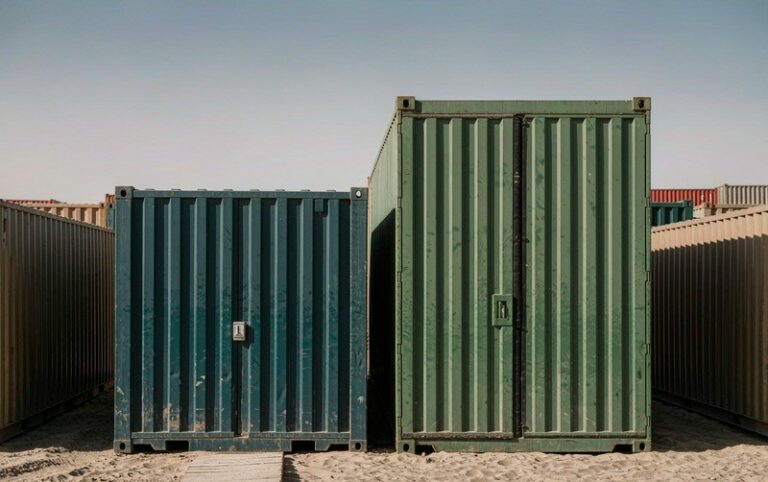
Three container sizes dominate aluminum export. Their internal dimensions, tare weight, and maximum payload determine every loading decision. Aluminum is light per unit volume but heavy per coil, so container payload (weight capacity) is almost always the first limit you hit — not cube.
Standard ISO Shipping Container Dimensions & Payload
| Container Type | Internal Length (m) | Internal Width (m) | Internal Height (m) | Internal Volume (m³) | Tare Weight (kg) | Max Payload (kg) |
|---|---|---|---|---|---|---|
| 20ft GP (1×TEU) | 5.90 | 2.35 | 2.39 | 33.1 | 2,200 | 28,180 |
| 40ft GP (2×TEU) | 12.03 | 2.35 | 2.39 | 67.5 | 3,700 | 26,680 |
| 40ft HC (High-Cube) | 12.03 | 2.35 | 2.69 | 76.2 | 3,900 | 28,560 |
| 20ft OT (Open Top) | 5.90 | 2.35 | 2.39 (no roof) | 33.1 | 2,300 | 28,080 |
| 40ft FR (Flat Rack) | 12.03 | 2.35 | 2.39 | 67.5 | 4,800 | 45,000 |
Aluminum Coil Loading: The Most Volume-Sensitive Form
Coils are the most common aluminum export form and the most loading-sensitive. A 5052-H32 coil at 1,200 mm width, 1.0 mm thickness, weighs 1,060 kg per coil. But a 3003-H16 coil at 1,500 mm width, 0.5 mm thickness weighs 2,030 kg and has an outer diameter of 1,800 mm — it dominates the container length. Coil loading is governed by three variables: inner diameter (ID), outer diameter (OD), and width.
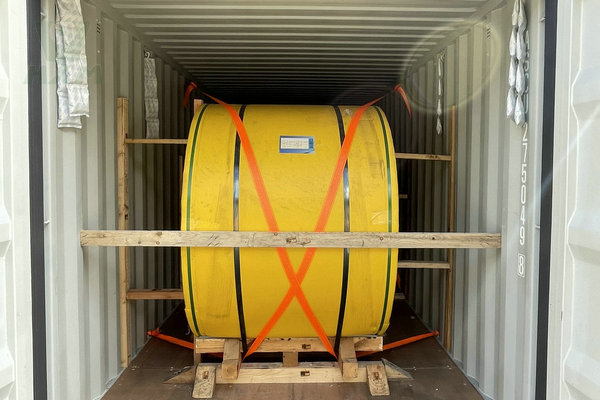
Eye-view longitudinal loading (coils standing upright on a wooden saddle, eye facing the container doors) maximizes payload per container and protects the coil from telescoping damage. HXM loads the majority of its export coils in this configuration.
Coil Loading Capacity by ID, OD, and Width
The table below shows typical payloads for common coil dimensions. These are indicative values based on standard 5052/3003/6061 series aluminum at coil density 2.71 g/cm³. Actual payload depends on temper, alloy density, and dunnage weight.
| Coil Spec (mm) | Typical Coil Mass (kg) | Coils per 20ft | Coils per 40ft HC | Payload 20ft (t) | Payload 40ft HC (t) |
|---|---|---|---|---|---|
| 1,200 × Ø OD 1,200 × ID 508 | ~1,000 | 8–9 | 20–22 | 8–9 | 3–4 (eye-view) |
| 1,500 × OD 1,500 × ID 508 | ~1,500 | 5–6 | 12–14 | 7–9 | 4–5 |
| 1,000 × OD 1,800 × ID 508 | ~2,000 | 4–5 | 10–12 | 8–10 | 22–26 |
| 1,250 × OD 1,800 × ID 610 | ~2,300 | 3–4 | 8–10 | 7–9 | 20–24 |
| 1,500 × OD 1,800 × ID 610 | ~2,800 | 3 | 7–8 | 8 | 22–24 |
Eye-view longitudinal loading on dunnage saddles typically yields 5–10% higher payload than flat (horizontal) loading. Flat loading is used for heavy-gauge coils (>3 mm) where lifting equipment can handle the mass.
Aluminum Sheet & Plate Loading: Thickness Drives Payload
Aluminum sheet and plate load differently from coil. Sheets are typically shipped flat on wooden pallets or in wooden crates, stacked horizontally with paper interleaving between sheets to prevent scratching. Thickness is the dominant variable: a 6 mm plate stacks 1/12 the sheets of a 0.5 mm sheet for the same stack height, but each sheet is 12x heavier — so the stack mass is the same.
The standard export pallet is 1,200 × 1,000 mm or 1,500 × 1,000 mm, weighing 1,000–1,800 kg per pallet depending on sheet thickness and stack height.
Sheet and Plate Loading Capacity by Thickness
| Thickness (mm) | Sheets per Standard Pallet | Pallet Mass (kg) | Pallets per 20ft | Pallets per 40ft HC | Payload 20ft (t) | Payload 40ft HC (t) |
|---|---|---|---|---|---|---|
| 0.5 | 300–400 | ~1,000–1,300 | 14–16 | 16–18 | 14–20 | 20–23 |
| 1.0 | 180–220 | ~1,200–1,500 | 14–16 | 16–18 | 17–24 | 22–26 |
| 2.0 | 100–120 | ~1,300–1,600 | 13–15 | 15–17 | 17–24 | 23–26 |
| 6.0 | 35–45 | ~1,400–1,800 | 13–14 | 14–16 | 18–25 | 23–27 |
| 12.0 | 18–22 | ~1,500–1,800 | 13–14 | 14–16 | 19–25 | 24–27 |
Aluminum Bar and Rod Loading: Long-Length Bundling
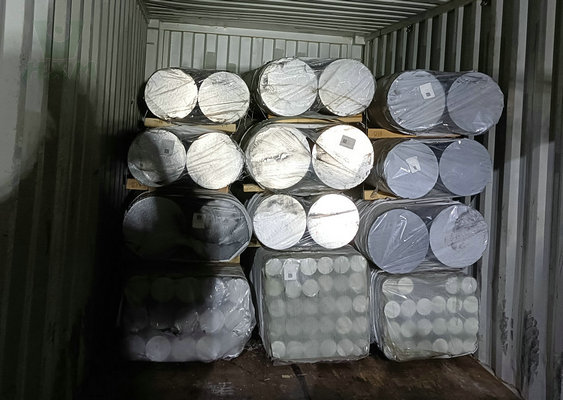
Aluminum bars and rods are typically 6 m (20 ft) length, exported in steel-strapped bundles weighing 1–2 t each. Standard export lengths include 6 m (China / Asia / Europe), 12 ft (3.66 m, North America), and 16 ft (4.88 m, North America). For 6 m bars in a 40ft container, you can fit roughly 20–28 bundles per container depending on bar diameter and bundle weight.
Bundles are stacked on wooden dunnage (typically 4–6 stringers) and braced with steel strapping. Larger-diameter bars (>50 mm) are typically loaded in custom cradles to prevent rolling. For our 6061 aluminum bar line, HXM ships most export orders in 1 t bundles on standard 4-stringer wooden pallets.
Aluminum Bar Loading Capacity by Length and Bundle Weight
| Bar Length | Bundle Weight | Bundles per 20ft | Bundles per 40ft | Payload 20ft (t) | Payload 40ft (t) |
|---|---|---|---|---|---|
| 6 m (20 ft) | 1 t | 20–22 | 24–26 | 20–22 | 24–26 |
| 6 m (20 ft) | 2 t | 10–11 | 12–13 | 20–22 | 24–26 |
| 3.66 m (12 ft) | 1 t | 26–28 | 26–28 | 26–28 (cap) | 26–28 (cap) |
| 4.88 m (16 ft) | 1 t | 22–24 | 24–26 | 22–24 | 24–26 |
| Custom cut <3 m | 1 t | 26–28 | 26–28 | 26–28 (cap) | 26–28 (cap) |
Bundle weight is set by lifting-equipment limits (1–2 t is standard). Container payload capped by chassis weight rating; see Incoterms and road-limit tables below.
Aluminum Tube Loading: Diameter-Sensitive Packing
Aluminum tubes are hollow sections, so they pack more cube-efficiently than solid bars but at lower payload density. Small-diameter tubes (<Ø 25 mm) are typically bundled in hexagonal-packed 500–800 kg bundles and stacked 2–3 bundles high. Larger tubes (Ø 50–150 mm) are nested in wooden cradles or steel frames, often individually wrapped.
Key loading rule: small-diameter tubes have lower bulk density (~250–400 kg/m³) than large-diameter tubes (~500–800 kg/m³), so a 40ft HC loaded with Ø 20 mm tube may only hit 14–18 t of payload — below the 26 t capacity — because you run out of cube before weight. For dense-loading applications like HVAC condensers and heat exchangers, use 6061 tube in larger diameters to maximize payload.
Typical tube loading payloads:
- Ø 6–12 mm tube, 6 m length, hexagonal bundles: 14–18 t / 40ft HC
- Ø 25–50 mm tube, 6 m, wooden cradles: 18–22 t / 40ft HC
- Ø 50–150 mm tube, 6 m, individual wrapping: 20–25 t / 40ft HC
Aluminum Foil Loading: Roll Density and Container Cube Limits
Aluminum foil is the most cube-sensitive aluminum export. A household foil roll at 30 cm × 75 m weighs only 200–300 g — essentially all air. Industrial foil rolls at 1.2 m width, 0.02–0.10 mm gauge, weigh 50–400 kg per roll, depending on gauge and core.
Foil loading rule: thin gauges (<0.020 mm) hit cube limits first; thicker gauges (> 0.05 mm) hit payload limits first. HXM loads foil in two configurations: roll-on-end (roll standing on the core, maximum rolls per container) or roll-flat (roll laying horizontal, better for stack stability). For our household and industrial foil line, roll-on-end loading is standard for export orders.
Typical foil payloads:
- Household foil (0.011–0.020 mm), small rolls, master cartons: 8–12 t / 40ft HC
- Container foil (0.04–0.10 mm), 1.2 m industrial rolls: 12–16 t / 40ft HC
- Pharmaceutical foil (0.02–0.05 mm), small rolls on pallets: 10–14 t / 40ft HC
Need optimized loading for your aluminum order?
HXM’s logistics team calculates 20ft/40ft packing plan per shipment — dunnage, weight distribution, bracing. Send your specs for a free loading plan.
Dunnage and Bracing Specifications for Aluminum
Dunnage is the wooden, steel, or cardboard material used to separate, support, and brace cargo inside a container. For aluminum, dunnage has three jobs: (1) protect cargo from damage, (2) distribute weight to prevent container-floor overload, and (3) allow forklift access for loading and unloading.
| Dunnage Material | Cost per Unit | Strength (kg/cm²) | Moisture Barrier | Recyclability | Typical Use |
|---|---|---|---|---|---|
| Softwood lumber (pine/fir) | $0.8–1.5/board-ft | High (~400) | Poor (needs VCI) | Yes (reused) | Coil saddles, sheet pallets, bracing |
| Hardwood (oak/birch) | $1.5–3.0/board-ft | Very high (~520) | Poor (needs VCI) | Yes (reused) | Heavy plate, dense bar bundles |
| Plywood crates | $2‒8/crate | Medium (~350) | Good (sealed) | Limited | Sheet/plate exports, foil master cartons |
| Corrugated cardboard slip-sheets | $0.5–2/sheet | Low (~80) | Excellent | Yes (compostable) | Light foil, anodized sheet, finished goods |
| Steel strapping | $0.05–0.15/m | Tension 800–1,500 kg | N/A | Yes (recycled) | All coil, bar, bundle shipments |
| Steel angles / bracing | $2–5/piece | Very high | N/A | Yes (recycled) | Plate stacks, heavy bar bundles |
Softwood lumber (pine/fir 4×4 stringers and 2×4 bracing) is the most common dunnage globally. For ISPM-15 compliance (heat treatment or fumigation of wood packaging), ensure your supplier provides heat-treated (HT) dunnage with the IPPC stamp. China exports must comply.
Anti-Rust Protection During Ocean Transit
Aluminum forms a self-healing oxide layer that prevents rust. However, water staining and surface oxidation are not rust — they are cosmetic damage that devalues the product and forces downstream buyers to re-polish or re-anodize. Three protective measures are standard on export shipments:
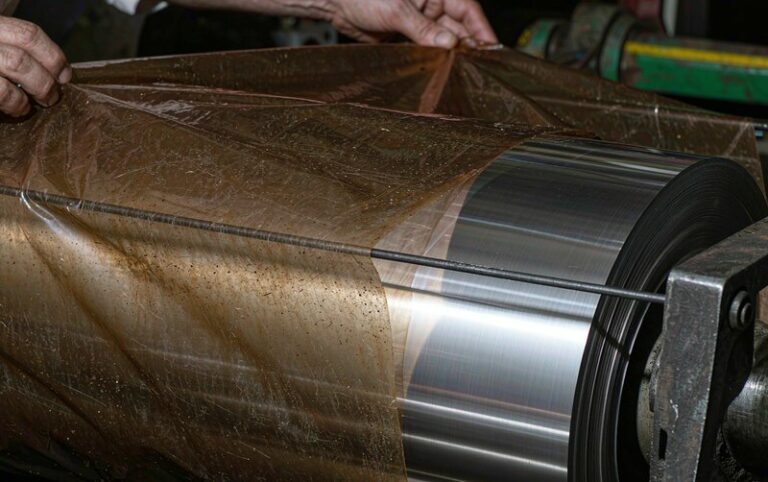
1. VCI (Volatile Corrosion Inhibitor) paper. VCI paper is kraft paper impregnated with amine-based inhibitors that vaporize and form a thin molecular film on the metal surface. This film prevents water staining for 12–18 months in dry storage. VCI paper is the standard export protection for coil, sheet, plate, bar, and finished parts. Cost: $0.10–0.30/m².
2. Desiccants (silica gel). Silica gel bags (typically 50–500 g) absorb moisture inside the container. Standard load: 10–20 kg of desiccant per 40ft for ocean transit. Cost: $1–3 per kg.
3. Sealed shrink-wrap or vacuum bags. For high-finish products (anodized, mirror-polished, painted), shrink-wrap or vacuum-bag packaging prevents oxygen and moisture contact. Cost: $2–10 per pallet.
HXM’s standard export packing is VCI paper + silica gel + heat-treated wooden pallet. Read more about aluminum corrosion behavior to understand when VCI is essential vs optional.
Weight Distribution and Center of Gravity in Container Loading
Container ships and chassis are sensitive to weight distribution. The center of gravity (CoG) must be near the container’s geometric center to prevent listing, rolling, and tipping during lifting, road transport, and ship motion. For a 40ft container loaded with aluminum, target the following distribution:
- Front quarter (0–3 m from doors): 25±1% of total mass
- Mid-front (3–6 m): 25±1%
- Mid-rear (6–9 m): 25±1%
- Rear quarter (9–12 m): 25±1%
For heavier loads (> 24 t in a 40ft), place 55% of mass in the rear half to compensate for the chassis tandem-axle load. For coil loading, heaviest coils should be loaded last and placed low. For sheet/plate stacks, heaviest pallets at the bottom, lightest on top — like a pyramid.
Improper CoG is the root cause of most container “shift at sea” incidents, where cargo slides inside the container during heavy weather. Even with proper lashing, CoG off-center >5% dramatically increases risk.
LCL vs FCL — When to Consolidate Container Loading
LCL (Less than Container Load) is attractive for small orders but expensive per ton. FCL (Full Container Load) wins on cost and damage rate above a volume threshold that depends on lane, alloy, and form. The table below shows typical LCL break-even thresholds for aluminum.
| Order Volume | Recommended Mode | Reasoning |
|---|---|---|
| < 3 t (any form) | LCL (air if urgent) | FCL fixed cost spread over too few tons |
| 3–12 t coil, sheet, plate, bar | LCL (consolidation) | LCL rate 1.5–2x FCL per ton but no fixed-cost burden |
| 12–22 t (fits in 20ft) | FCL 20ft | Full 20ft at $80–180/t beats LCL |
| 22–28 t (fits in 40ft) | FCL 40ft | Optimal payload utilization |
| > 28 t | FCL 40ft × 2 or 40ft HC × 2 | Multi-container FCL beats LCL and partial |
LCL break-even shifts up or down by $30–50/t depending on freight lane (US West Coast vs EU vs Middle East vs South America) and oil-price-driven bunker adjustments. For volatile markets, request both LCL and FCL quotes.
Hazmat Considerations: Battery and Anodized Aluminum
Most aluminum is non-hazardous for ocean transport. Two categories require attention:
1. Aluminum for lithium battery applications. Aluminum foil and tab stock used in lithium-ion battery manufacturing must be clean and grease-free per battery-maker specs (typically <0.5 mg/m² of oil residue). This is a quality requirement, not a hazmat classification — but the product may require special documentation for some battery-grade certifications.
2. Anodized aluminum. Anodized aluminum is non-hazardous. However, anodizing chemicals (sulfuric acid, chromic acid) used in process tanks are hazmat Class 8 corrosive and cannot ship in the same container as finished anodized parts. If HXM ships anodized coils, they are cleaned, dried, and packed separately from any chemical shipments.
For most aluminum exports — coil, sheet, plate, bar, tube, foil, wire — no hazmat declarations are required. UN number is generally not assigned to bare aluminum mill products.
Container Marking and Documentation for Aluminum Export
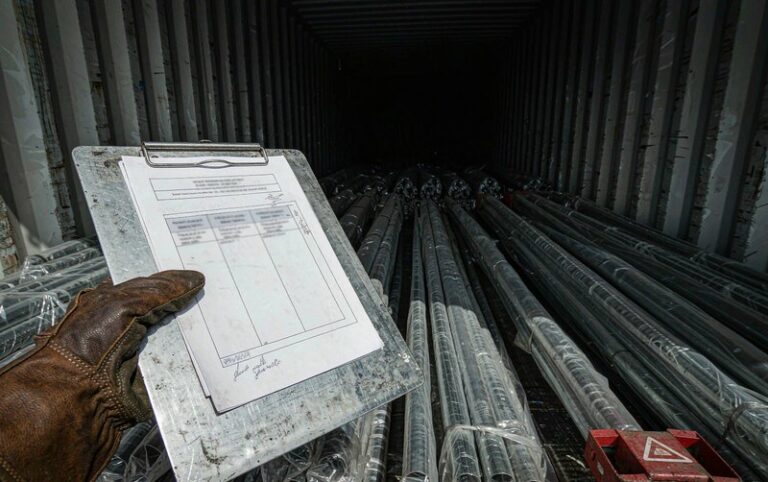
Every aluminum export container requires standard shipping marks and documentation. Missing marks cause delays at destination, customs holds, and demurrage charges. Required markings and docs include:
- Shipping marks (3-line minimum): buyer name, PO number, destination port, package number (“1 of 24”, “2 of 24”, etc.)
- Weight marks: gross weight and net weight per package, especially for packages >1 t
- Side marks: “THIS SIDE UP” arrows for sheet and plate stacks, coil orientation arrows for eye-view coils
- Country of origin: “MADE IN CHINA” or country-specific marking per destination customs rules
- ISPM-15 mark: IPPC stamp on all wooden dunnage (heat-treated or fumigated)
- Bill of Lading (B/L): clean B/L with correct commodity description (“ALUMINUM COIL”, “ALUMINUM SHEET”, etc.), HS code (7606 for sheet, 7605 for coil, 7604 for bar/rod, 7608 for tube, 7607 for foil)
- Packing List: detailed package-by-package contents with weight and dimensions
- Commercial Invoice: with HS code, country of origin, unit/tonnage value
- Certificate of Origin (C/O): issued by China Chamber of Commerce or authorized agent
- Mill Test Certificate (MTC): EN 10204 3.1 cert standard for chemical composition and mechanical properties
Damage Prevention Best Practices for Aluminum in Transit
The top three damage modes for aluminum in ocean containers are: (1) coil telescoping (eye-view coil collapses and becomes a flat oval), (2) sheet scratching (inter-sheet abrasion during road vibration), and (3) water staining (condensation or rainwater ingress). Prevention:
For coils: use eye-view saddles (wooden V-blocks or steel saddles) sized to coil ID. Block coil from above with bracing boards secured to container walls. Never let a coil “free-roll” inside the container. The coil should be snugly held with <2 cm of horizontal movement at the eye.
For sheets: paper-interleave between every sheet (kraft paper or neutral PH paper). Wrap pallet in VCI paper or shrink-wrap. Use edge protectors on all four corners. For anodized or polished sheets, add foam sheet on top.
For bars and rods: bundle with steel strapping (minimum 4 straps per bundle, tensioned to 800–1,500 kg). Use wooden cradles or hexagonal packing for small-diameter rods. Block bundle movement with bracing boards at container ends.
For tubes: end-cap plastic protectors on both ends. Bundle small-diameter tubes with steel strapping or nylon strapping. Block bundle ends with dunnage.
For foil: keep in original master cartons. Master cartons on pallets. Shrink-wrap entire pallet. Avoid stacking more than 2 pallets high — foil rolls deform under compression.
Container Loading Inspection Checklist (Pre-Shipment)
Use this checklist before container sealing. Most aluminum claims at destination trace back to one of these items being skipped.
✅ Pre-Shipment Container Loading Checklist
- Container interior inspected for previous cargo residue, nails, sharp edges — cleaned and lined if needed
- Floor dry, no standing water — dry desiccant if any moisture present
- Container walls and ceiling free of condensation stains — ventilated if needed
- Coil saddles (V-blocks) correctly sized to coil ID — check at every coil
- Sheet pallets: paper-interleave verified, edge protectors in place, shrink-wrap intact
- Bar/tube bundles: steel strapping tensioned, ends blocked, no free movement
- Foil pallets: master cartons intact, shrink-wrap tight, stacking height ≤ 2 pallets
- Weight distribution: front 25% / mid-front 25% / mid-rear 25% / rear 25% ±2%
- Total payload within 40ft max (26.7 t GP, 28.6 t HC) or 20ft max (28.2 t)
- Bracing boards secured to container side rails with nails/screws (no staples alone)
- VCI paper in place for all coil, sheet, plate shipments
- Desiccant bags (10–20 kg) hung from ceiling rings or placed between pallets
- Shipping marks visible on container doors and on each package
- ISPM-15 IPPC mark visible on all wooden dunnage
- Container doors closed and sealed with high-security seal (bolt seal or e-seal), seal number noted
- Photos taken: container interior pre-load, mid-load, post-load, seal application
Incoterms 2020 — Impact on Container Loading Responsibility
Incoterms 2020 (effective Jan 1, 2020) determines who pays for and who is responsible for loading, drayage, customs, and risk transfer. For aluminum buyers, four Incoterms matter most: EXW, FOB, CIF, and DDP.
| Incoterm | Loading Responsibility | Freight Payment | Risk Transfer | Best For |
|---|---|---|---|---|
| EXW (Ex Works) | Buyer (you arrange everything) | Buyer | At seller’s factory gate | Buyers with own freight forwarder in China |
| FCA (Free Carrier) | Seller loads to buyer’s truck/forwarder | Buyer | When loaded onto buyer’s truck | Most common for container FOB |
| FOB (Free On Board) | Seller loads to vessel at origin port | Seller | When on board vessel | Standard ocean export, buyer controls freight |
| CIF (Cost, Insurance, Freight) | Seller loads + freight + insurance to dest port | Seller | When on board vessel | Buyers wanting one price for goods + freight |
| DAP (Delivered At Place) | Seller delivers to buyer’s named place | Seller | At named place | Buyers without import capability |
| DDP (Delivered Duty Paid) | Seller delivers + pays all customs duties | Seller | At buyer’s named place, duty paid | Buyers wanting zero-hassle import |
HXM is flexible on Incoterms but most export orders ship FOB or CIF. For FOB, we handle container loading at our China mill; the buyer’s nominated forwarder picks up the loaded container. For CIF, we book the vessel and pay freight to your destination port. Read our price trends and freight guide for current landed-cost math.
Sustainability: Reducing Air Freight and Packing Waste
Two sustainability levers are under buyer control: (1) avoid air freight by holding larger inventory and ordering full containers, and (2) require returnable/reusable dunnage from your supplier.
Air freight for aluminum is 8–12x more CO₂-intensive per ton than ocean freight. A typical 1 t air shipment from Shanghai to Los Angeles generates ~6.5 t CO₂; the same ton by ocean generates ~0.4 t CO₂. The 16x difference is the carbon cost of urgency. Buyers who consolidate orders and accept 30–45-day transit (rather than demanding 7-day air) reduce their Scope-3 transport footprint dramatically.
On dunnage, the most sustainable option is returnable steel cradles (used for coil and bar shipments between recurring supplier and buyer). Steel cradles last 50+ round trips and eliminate the 30 kg of wood waste generated per container of softwood dunnage. For one-off orders, FSC-certified softwood and recycled-cardboard slip-sheets are the next-best option.
HXM offers returnable steel cradles on recurring contracts and FSC-certified dunnage on one-off orders. Read our aluminum recycling and sustainability guide for the broader picture.
Need a loading plan for your next aluminum order?
HXM’s logistics team calculates optimal 20ft/40ft packing — dunnage, weight distribution, bracing — for each shipment. Send your specs for a free loading plan and quote.
Frequently Asked Questions: Container Loading for Aluminum
How much aluminum fits in a 20ft container?
A 20ft GP container has a 28.2 t payload limit. For aluminum sheet on pallets, expect 17–24 t depending on thickness. For bar/rod in 1 t bundles, expect 20–22 t (20–22 bundles). For tubes, expect 18–22 t depending on diameter. For foil, expect only 8–12 t because cube limits are reached before weight. Always verify with your supplier’s specific loading plan for your alloy, temper, and dimensions.
How much aluminum fits in a 40ft container?
A 40ft HC container has a 28.6 t payload limit and 76 m³ internal volume. Coil aluminum typically loads 22–26 t per 40ft HC. Sheet/plate typically loads 23–26 t. Bar/rod typically loads 24–26 t. Tubes 18–22 t. Foil 8–16 t. The actual payload is limited by the lighter of payload capacity and usable cube, whichever hits first.
What is the max payload for aluminum coil in a 40ft?
For standard 5052/3003/6061 coil at 1.0–1.5 mm thickness and 1,200–1,500 mm width, eye-view longitudinal loading typically achieves 22–26 t per 40ft HC. The theoretical max is ~28 t if you pack very narrow coils (600–800 mm width) with minimum dunnage, but this is rarely done in practice because of handling constraints.
How to prevent aluminum coil damage during shipping?
Three steps: (1) use VCI paper wrapping between coil layers and around the entire coil; (2) load coils eye-view on wooden V-block saddles sized to the coil ID; (3) block coil movement with bracing boards nailed to container side rails. Coil telescoping (eye collapse) is the #1 damage mode — caused by under-sized saddles or insufficient bracing.
What is the best dunnage for aluminum sheet?
For most sheet shipments: heat-treated softwood pallets (ISPM-15 compliant), paper interleaving between every sheet (kraft or neutral-PH), edge protectors on all four corners, and VCI paper wrap over the entire pallet. For anodized or polished sheet, add foam sheet on top and consider vacuum-bag packaging. Plastic strapping (PET) is preferred over steel for anodized sheet to avoid rust staining from steel.
Should I use FCL or LCL for aluminum?
Use FCL when your order exceeds 12–22 t (one full 20ft) or 22–28 t (one full 40ft). Use LCL for orders under 12 t. FCL wins on per-ton cost and damage rate above the break-even point; LCL is more flexible for small orders but typically costs 1.5–2x per ton and has higher handling damage risk because of multiple consolidations.
How to reduce container air space?
Three techniques: (1) eye-view longitudinal coil loading packs coils in the long axis and uses vertical cube efficiently; (2) for sheet, use full pallets that fill the container width (2,350 mm) and stack height; (3) for bar/rod, pack hexagonal bundles that nest tightly. Air space above 10–15% of internal volume indicates suboptimal packing.
What is the road weight limit for a 40ft container?
Road weight limits vary by jurisdiction. USA: 36.3 t gross (chassis + container + cargo) on interstate highways. EU: 40 t gross on standard roads, 44 t on combined-transport corridors. China: 49 t for 40ft semi-trailer. Australia: 42.5 t gross. Always verify with the destination country’s road-transport authority; overweight fines can exceed $5,000 per incident.
Do I need wooden or steel dunnage?
Wood dunnage (heat-treated softwood) is the standard for coil, sheet, plate, and bar shipments — cheaper, easier to handle, ISPM-15 compliant. Steel dunnage (cradles, frames) is used for heavy plate (> 15 mm), large bar bundles, and returnable-reusable programs. Cardboard is reserved for light foil and finished anodized products. Most HXM shipments use wooden dunnage.
How does Incoterms 2020 affect loading?
Under EXW, the buyer handles all loading at the seller’s factory. Under FCA/FOB, the seller loads the container. Under CIF/DAP/DDP, the seller loads, ships, and delivers. Loading responsibility affects who bears the risk of damage during loading. Most aluminum contracts are FOB or CIF, meaning the seller is responsible for safe loading and the buyer assumes risk once the container is on the vessel.
How much does container shipping cost per kg for aluminum?
Ocean freight rates fluctuate widely. Trans-Pacific (China to US West Coast): $80–180/t in 2026. Trans-Pacific to US East Coast: $130–240/t. Asia to EU: $100–200/t. Intra-Asia: $40–80/t. Add inland drayage $30–60/t and customs/clearance $10–30/t. At 26 t per 40ft, per-kg cost works out to $0.04–0.15/kg for ocean only.
Does HXM provide loading optimization for orders?
Yes. HXM’s logistics team calculates the optimal 20ft or 40ft loading plan for every order — coil, sheet, plate, bar, rod, tube, foil — including dunnage type, VCI protection, weight distribution, and bracing pattern. We share the plan with buyers before shipment for review. Send your alloy, temper, dimensions, and order quantity for a free loading plan and quote.
Get Your Aluminum Loaded Optimally with HXM
This guide covered form-specific aluminum loading rules — coil, sheet, bar/rod, tube, foil, and wire — across 20ft, 40ft GP, and 40ft HC containers. The core takeaway: weight is your primary constraint for coil/sheet/plate/bar, but cube is the primary constraint for foil and small-diameter tube. Dunnage (wood, steel, cardboard) and bracing are the difference between a 22 t container and a 26 t container at the same destination.
For sourcing context, read our complete China sourcing guide, the 2026 price and market trends report, and our sustainability guide. For product specs, see 5052 coil, 6061 sheet, and 6061 bar.
HXM Aluminum supplies coil, sheet, plate, bar, rod, tube, foil, and wire in 1xxx, 3xxx, 5xxx, 6xxx, and 7xxx series — MOQ 1–3 t, lead time 15–25 days, EN 10204 3.1 mill certificate standard. We ship FOB, CIF, and DDP globally. Every shipment includes a pre-calculated loading plan, VCI paper, desiccants, heat-treated ISPM-15 dunnage, and a pre-shipment photo record.
Request a Free Loading Plan & Quote
Send your alloy, temper, dimensions, and order quantity. HXM’s logistics team returns a 20ft/40ft loading plan + quote within 24 hours.