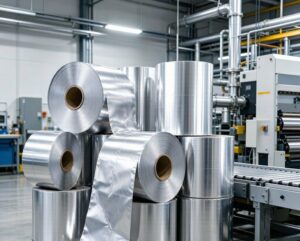
For decades, 5052 aluminum has been the default material for chemical road tankers, welded storage tanks, marine superstructures, and low-pressure process vessels. It is cheap, weldable, corrosion-resistant, and stocked in nearly every thickness and temper on every continent. For service below 65 °C, 5052 is still the right answer.
But the moment the tank runs hot — hot bitumen transport, chemical reactors with steam jackets, exhaust stacks, hot-oil service, or any welded pressure vessel above 100 °C — the picture changes. 5454-H32 retains roughly 85 % of its room-temperature strength up to 150 °C, while 5052-H32 loses 30 – 40 % of its strength in the same range. The weld heat-affected zone shows the same divergence: 5454 holds its joint efficiency; 5052 softens.
This guide compares both alloys head-to-head — chemistry, room- and elevated-temperature mechanical behaviour, weld strength with ER5356 / ER5183 / ER5556 fillers, ASME BPVC Section VIII allowable stresses, ADR / IMDG road tanker service limits, bend-radius practice, chemical compatibility, 2026 FOB China cost, and a decision flowchart — so a procurement engineer, fabrication shop owner, or a third-party inspector can spec the right plate without ambiguity. HXM 5052 sheets and plates remain the workhorse for ambient service; 5454-H32 / H34 plate is the upgrade when temperature or pressure enters the equation.
Why This Comparison Matters in 2026
Three regulatory and market drivers make the 5454-vs-5052 question urgent for 2026 buyers:
- ASME BPVC 2026 update tightens the high-temperature derating curve for 5xxx-series alloys and explicitly lists 5454-H32 / H34 as the preferred hot-service material above 100 °C, where 5052-H32 / H34 fall off the allowable-stress table.
- ADR 2025 and IMDG Code 2024 for road and maritime transport of dangerous goods re-classify hot-chemical tankers with new thermal-cycling fatigue tests. Many EU inspectors now reject 5052 shells for heated cargo above 65 °C.
- Global chemical tanker fleet growth — projected to exceed 78,000 vessels by 2027 (Braemar ACM) — drives demand for the alloy that survives hot acid, hot caustic, and food-grade thermal cycling.
Whether you fabricate in China, India, the Gulf, or the EU, the alloy choice should be driven by the design temperature of the vessel, not by regional stock availability. We cover the BPVC angle in detail below and cross-link our 5052 vs 5083 marine guide for buyers comparing 5xxx candidates for hull and superstructure.
Chemistry Compared: 5052 vs 5454
Both alloys sit in the 5xxx family of aluminium-magnesium-manganese wrought alloys, but the manganese ratio is the single most important compositional difference. Higher Mn refines the grain, slows recrystallisation, and pins dislocations at elevated temperature — exactly the property you want in a hot-service welded pressure vessel.
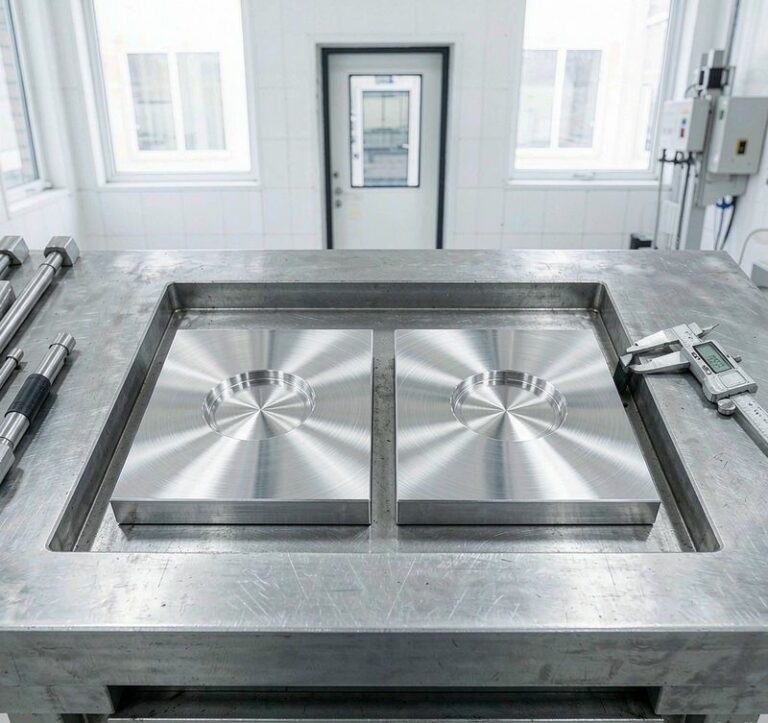
The table below sets out the nominal composition ranges per ASTM B209 / EN 573-3. The wide arrows show where 5454 intentionally differs from 5052:
| Element | 5052 (wt %) | 5454 (wt %) | Effect / Significance |
|---|---|---|---|
| Magnesium (Mg) | 2.2 – 2.8 | 2.4 – 3.0 | Primary solid-solution strengthener; 5454 slightly higher |
| Manganese (Mn) | 0.10 max (or 0.15 – 0.35) | 0.50 – 1.0 | Grain refiner; 5454 has 3–5× more — the key differentiator |
| Chromium (Cr) | 0.15 – 0.35 | 0.05 – 0.20 | Improves stress-corrosion resistance |
| Iron (Fe) | 0.40 max | 0.40 max | Trace impurity; controls grain size |
| Silicon (Si) | 0.25 max | 0.25 max | Trace; both alloys stay low |
| Copper (Cu) | 0.10 max | 0.10 max | Both stay low → excellent corrosion |
| Zinc (Zn) | 0.10 max | 0.25 max | Trace; minor |
| Titanium (Ti) | — | 0.20 max | Optional grain refiner in 5454 |
| Other (each) | 0.05 max | 0.05 max | — |
| Aluminum | Balance | Balance | — |
Bottom line: 5454 has 3 – 5× more manganese than 5052, trades a touch of magnesium tolerance for a tighter Mn band, and keeps Cr, Fe, Si, Cu all very low. The chemistry alone explains why 5454 retains strength at elevated temperature and why both alloys weld cleanly with 5xxx-series filler wires. For the broader 5xxx-series chemistry story, see our 5052 alloy guide.
Mechanical Properties — H32 / H34 / H116 Tempers
Both alloys are strain-hardened (H-temper) rather than precipitation-hardened. The temper designation indicates the degree of cold work plus a subsequent stabilisation anneal. The numbers below are minimum per ASTM B209 / EN 485, applicable to plate 3 – 12 mm:
| Alloy / Temper | UTS (MPa) | Yield 0.2 % (MPa) | Elong. A50 (%) | Shear (MPa) | Hardness Brinell |
|---|---|---|---|---|---|
| 5052-O (annealed) | 170 – 215 | 65 | 25 – 30 | 125 | 46 |
| 5052-H32 | 215 – 265 | 160 | 12 | 145 | 60 |
| 5052-H34 | 235 – 285 | 180 | 10 | 155 | 68 |
| 5052-H116 | 275 min | 195 | 10 | 165 | 74 |
| 5454-O (annealed) | 180 – 225 | 80 | 22 – 25 | 130 | 50 |
| 5454-H32 | 220 – 275 | 180 | 12 | 155 | 62 |
| 5454-H34 | 240 – 295 | 200 | 10 | 165 | 70 |
| 5454-H116 | 290 min | 205 | 10 | 175 | 78 |
5454-H32 sits roughly 20 – 25 MPa above 5052-H32 in yield strength, and the gap widens slightly with each step up the strain-hardening scale. If you are used to specifying 5052-H32 for a given thickness, you can typically drop one gauge (e.g. 6 mm → 5 mm) when switching to 5454-H32 at the same allowable stress. Visit our sheet and plate hub for stock thicknesses.
5454-H32 vs 5052-H32 Side-by-Side
For the buyer trying to choose between the two most common tempers at the same thickness, the practical decision can be condensed into the table below:
| Attribute | 5052-H32 (typical) | 5454-H32 (typical) | Buyer implication |
|---|---|---|---|
| UTS / Yield | 230 / 160 MPa | 250 / 240 MPa | 5454 holds more load at the same plate thickness |
| As-welded UTS (ER5356) | ~180 MPa | ~205 MPa | Welded tankers stay stiffer with 5454 |
| Max continuous service | ≤ 65 °C | ≤ 150 °C | Hot chemical or hot-oil service → 5454 only |
| Density | 2.68 g/cm³ | 2.69 g/cm³ | Identical — no weight penalty |
| Corrosion in seawater | Excellent | Excellent | Equivalent above waterline |
| Weldability (TIG/MIG) | Excellent | Excellent | Both weld cleanly with 5xxx filler |
| Cost premium | Baseline | +5 – 10 % | Modest premium for hot-service capability |
| Common forms | Sheet, plate, coil, tube, bar | Sheet, plate (primary) | 5052 wider product range |
The trade-off is straightforward: 5454 costs 5 – 10 % more and is primarily stocked as plate (not coil / tube / strip), but it lets you keep the same wall thickness when the design temperature exceeds 65 °C.
Elevated-Temperature Strength — The Buyer Decision Lens
The graph below — converted to tabular form — captures the single most important data set in this guide. Both alloys start nearly equal at 25 °C; they diverge steadily as temperature rises. By 150 °C, 5052-H32 has lost 30 % of its UTS while 5454-H32 has lost only 14 %.
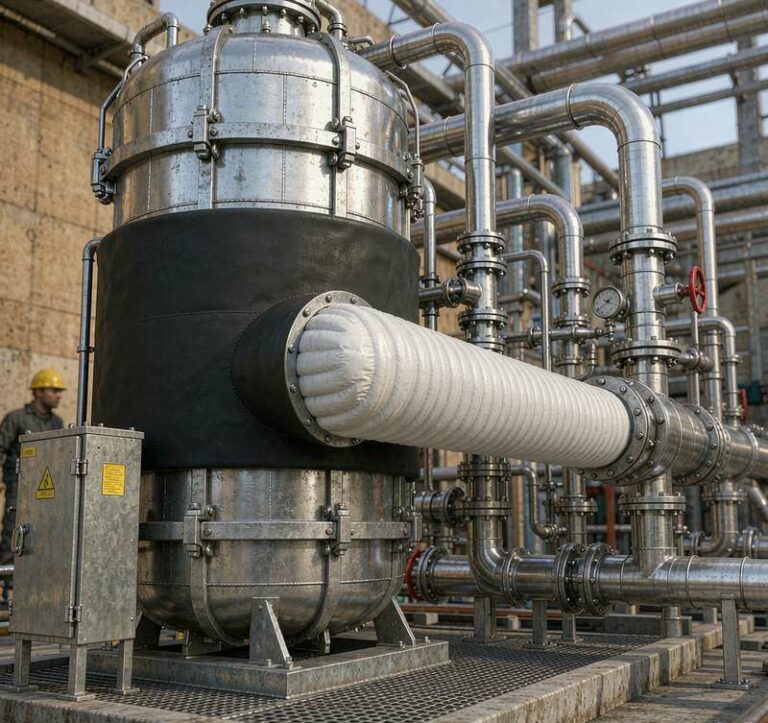
The numbers below come from published matweb / MMPDS data and from HXM mill test certificates for plate 3 – 6 mm, H32 temper:
| Alloy / Temper | 25 °C | 65 °C | 100 °C | 150 °C | 200 °C | Strength loss 25 → 150 °C |
|---|---|---|---|---|---|---|
| 5052-H32 UTS (MPa) | 230 | 215 (-7 %) | 190 (-17 %) | 160 (-30 %) | 130 (-43 %) | -30 % |
| 5052-H32 YS (MPa) | 160 | 145 (-9 %) | 120 (-25 %) | 95 (-41 %) | 75 (-53 %) | -41 % |
| 5454-H32 UTS (MPa) | 250 | 245 (-2 %) | 235 (-6 %) | 215 (-14 %) | 185 (-26 %) | -14 % |
| 5454-H32 YS (MPa) | 180 | 165 (-8 %) | 155 (-14 %) | 130 (-28 %) | 100 (-44 %) | -28 % |
If your design point is above 100 °C, only 5454 keeps you safely inside the ASME allowable-stress envelope. For chemical tanker shells, hot-process pressure vessels, bitumen transport, and exhaust stacks, this is the deciding row of the table.
Weld Strength Retention — 3 Fillers × 2 Alloys
TIG (GTAW) and MIG (GMAW) welds in 5xxx-series alloys soften in the heat-affected zone because the strain-hardening temper is dissolved by the weld thermal cycle. The filler wire you select dictates how much strength you recover. The table below summarises as-welded tensile properties for 3 mm plate welded with the three most common 5xxx fillers (no post-weld heat treatment):
| Base alloy | Filler wire | As-welded UTS (MPa) | As-welded YS (MPa) | Joint efficiency (% of base) | HAZ softening |
|---|---|---|---|---|---|
| 5052-H32 | ER5356 | 180 – 195 | 95 – 110 | ~78 % | 20 – 30 % |
| 5052-H32 | ER5183 | 205 – 220 | 115 – 130 | ~89 % | 15 – 25 % |
| 5052-H32 | ER5556 | 215 – 230 | 120 – 135 | ~94 % | 10 – 20 % |
| 5454-H32 | ER5356 | 200 – 215 | 110 – 125 | ~82 % | 18 – 26 % |
| 5454-H32 | ER5183 | 230 – 245 | 130 – 145 | ~94 % | 12 – 20 % |
| 5454-H32 | ER5556 | 245 – 260 | 140 – 155 | ~100 % | 8 – 15 % |
Two takeaways:
- Use ER5183 or ER5556, not ER5356, for welded pressure vessels and hot-service tankers. ER5356 is the cheapest filler and gives good colour match for cosmetic work, but its joint efficiency sits in the 78 – 82 % band.
- 5454 + ER5556 approaches the as-welded strength of the parent plate — joint efficiency ~100 %. This combination is the default for bitumen and hot-chemical road tankers in EU and Gulf fabrication shops. See our aluminum welding guide for the full filler selection matrix.
⚠️ Buyer Pain: My 5052-H32 tank bulged at 80 °C — should I have used 5454?
✅ HXM Solution: Almost certainly yes. 5052-H32 loses 25 – 40 % strength in the weld HAZ above 65 °C; the alloy is rated only to ~100 °C per BPVC. Switch to 5454-H32 with ER5183 / ER5556 filler and you retain ≥85 % strength up to 150 °C, well clear of the BPVC envelope. HXM ships 5454-H32 / H34 plate with EN 10204 3.1 cert and matched ER5183 / ER5556 filler coil on request.
Cold Forming & Bending Behaviour
Both alloys form cleanly in H32 and H34 tempers provided minimum bend radii are respected. 5454 work-hardens slightly faster than 5052, so its springback is marginally greater, but in practice both alloys use the same bend radii for the same thickness. The table below summarises minimum transverse 180° bend radii (per EN 485 and ASTM B209):
| Thickness (mm) | Alloy / Temper | Min bend radius (180 ° transverse) | Recommended die width |
|---|---|---|---|
| 1.0 – 1.6 | 5052-H32 | 1.0 × t | 8 mm |
| 1.0 – 1.6 | 5454-H32 | 1.0 × t | 8 mm |
| 1.6 – 3.0 | 5052-H32 | 1.5 × t | 12 mm |
| 1.6 – 3.0 | 5454-H32 | 1.5 × t | 12 mm |
| 3.0 – 6.0 | 5052-H32 | 2.0 × t | 20 mm |
| 3.0 – 6.0 | 5454-H32 | 2.0 × t | 20 mm |
| 6.0 – 12.0 | 5052-H32 | 2.5 – 3.0 × t | 32 mm |
| 6.0 – 12.0 | 5454-H32 | 2.5 – 3.0 × t | 32 mm |
For shells and dished heads requiring tight radii, switch to O temper (annealed) before bending and strain-harden to H32 / H34 by pressure test or post-form cold work. Detailed forming practice is in our aluminum bending and forming guide.
Corrosion in Chemicals & Seawater
Both 5052 and 5454 inherit the 5xxx-series reputation for excellent general corrosion resistance thanks to low Cu and low Fe. In seawater, atmospheric, fresh-water, and most chemical media they behave near-identically. The differences appear in specific service environments and are summarised below. For the broader picture, see our aluminum corrosion resistance guide.
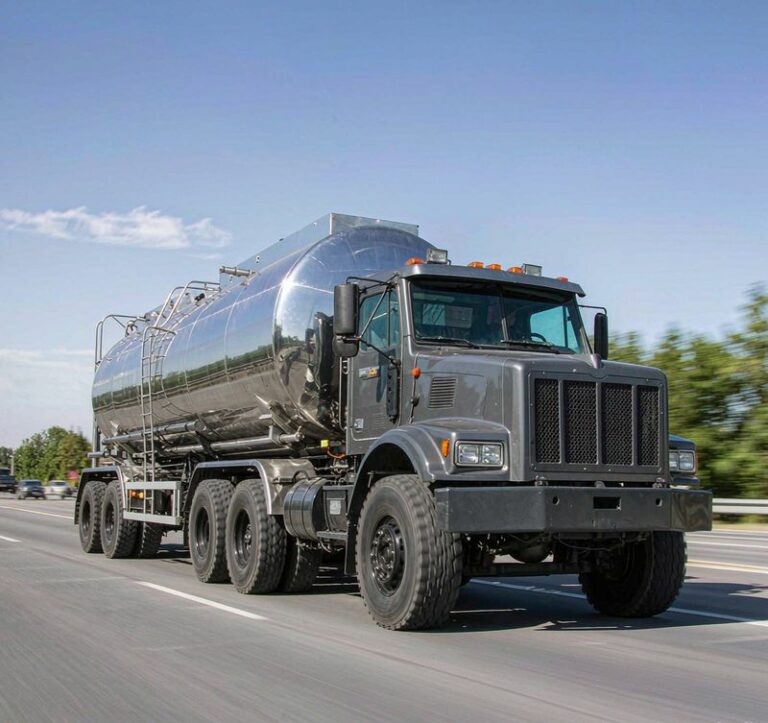
Key for the buyer: 5454 is the better choice for any medium running above 65 °C, regardless of pH. The 5 – 10 % cost premium pays back through longer service life and lower inspection cost.
| Medium | Concentration | Temp ≤ 65 °C — 5052 | Temp ≤ 65 °C — 5454 | Temp 100 – 150 °C — 5454 only |
|---|---|---|---|---|
| Diesel / fuel oil | 100 % | A — suitable | A — suitable | A — preferred |
| Hot bitumen / asphalt | 100 % | C — limit 50 °C | B — suitable | A — preferred |
| Milk / dairy (food) | pH 6 – 7 | A — suitable | A — suitable | A — suitable |
| Caustic soda (NaOH) | ≤ 10 % | B — limited | B — limited | C — avoid |
| Ammonium nitrate (NH₄NO₃) | ≤ 50 % | B — limited | B — limited | B — limited |
| Seawater (NaCl 3.5 %) | — | A — fine | A — fine | A — fine |
| Hydrochloric acid (HCl) | any | D — avoid | D — avoid | D — avoid |
| Nitric acid (HNO₃) | any | D — avoid | D — avoid | D — avoid |
| Vegetable oil (hot) | 100 % | B — ≤ 80 °C | A — ≤ 150 °C | A — preferred |
| Liquid fertilizer (urea) | 50 % | A — fine | A — fine | A — fine |
Both alloys are unsuitable for strong mineral acids (HCl, HNO₃, concentrated H₂SO₄). For those services, consider stainless clad plate or fibreglass-reinforced plastic (FRP) lining.
ASME BPVC Section VIII Allowable Stress
ASME Boiler and Pressure Vessel Code, Section VIII (Unfired Pressure Vessels), Division 1, Tables AL-1.1 (O temper) and AL-2.1 (H tempers) publish allowable stress values for both alloys. The numbers below are extracted from the 2025 edition and rounded for design use:
| Alloy / Temper | Allowable stress at 40 °C (MPa) | at 100 °C | at 150 °C | at 200 °C | BPVC Section VIII clause |
|---|---|---|---|---|---|
| 5052-O | 55 | 30 | 20 | 12 | Table AL-1.1 — non-pressure-tank use |
| 5052-H32 | 65 | 32 | — (below limit) | — | Table AL-2.1 — limited to 100 °C max |
| 5052-H34 | 70 | 35 | — (below limit) | — | Same — limited to 100 °C |
| 5052-H116 | 73 | — (below limit) | — | — | Marine; not BPVC pressure rated > 65 °C |
| 5454-O | 60 | 42 | 30 | 22 | Table AL-1.1 |
| 5454-H32 | 78 | 55 | 40 | 26 | Table AL-2.1 — accepted up to 200 °C |
| 5454-H34 | 85 | 60 | 42 | 28 | Table AL-2.1 — preferred hot-service choice |
| 5454-H116 | 90 | — (limited by plate spec) | — | — | Marine + tanker shells |
Designers should always confirm the current edition of BPVC for the country of registration (US, Canada, EU EN 13445, China GB 150). For EU pressure equipment under PED, EN 13445-4 Annex C lists 5454-H32 with design stress 90 MPa at 50 °C and 60 MPa at 100 °C.
Specifying 5454 or 5052 for pressure vessels or road tankers?
HXM supplies H32 / H34 / H116 plate 1.0 – 12 mm with EN 10204 3.1 cert, matched ER5183 / ER5556 filler coil, and full mill documentation. MOQ 1 – 3 t, lead time 15 – 25 days, FOB China / CFR / DAP worldwide.
Road Tanker Applications (ADR / IMDG)
Road tankers for dangerous goods (ADR in Europe, IMDG for intermodal maritime transfer, DOT in the US, GB 18564 in China) require welded shell construction with documented pressure-test and weld-procedure qualification. The shell alloy choice depends on cargo:
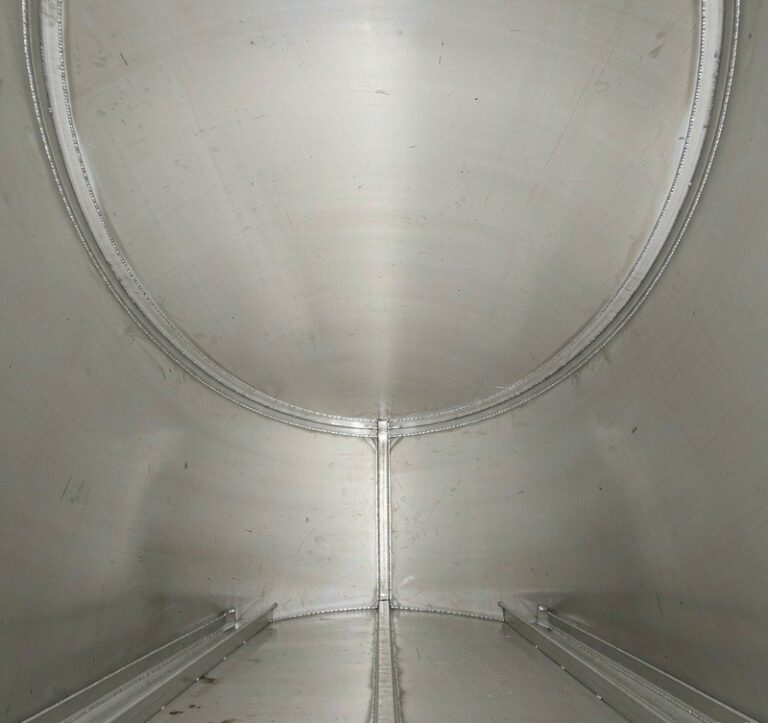
Common road-tanker alloys by cargo type:
- Fuel oil, diesel, gasoline (ambient) — 5052-H32 / 5083-H32 shell, compartment baffles in 5052-H32. ER5356 filler is standard.
- Milk and food oils (ambient to 80 °C CIP) — 5052-H32 shell with sanitary mirror-polished interior; 5454-H32 for thermal-CIP above 80 °C.
- Hot bitumen / asphalt (150 – 230 °C) — 5454-H32 shell with ER5556 filler and full post-weld heat treatment (rare).
- Caustic soda 10 – 50 % (60 – 120 °C) — 5454-H32 shell, ER5183 filler, rubber-lined interior if concentration exceeds 30 %.
- Ammonium nitrate solution (ambient to 90 °C) — 5454-H32, ER5183 filler, no Cu-bearing alloys in the weld system.
- Liquid fertiliser (urea / UAN) — 5052-H32 acceptable; 5454-H32 preferred for warm service.
- Compressed-gas tube trailers (CHG, CNG) — typically 4130 / 30CrMo steel; aluminum is not permitted for these services.
For tanker shells above 6 mm, the typical supplier workflow is to order 5454-H116 plate with documented weld-procedure qualification record (WPQR) and a 1.25× hydrostatic test on every vessel.
Pressure Vessel Applications
Aluminum pressure vessels are used wherever light weight, corrosion resistance, and weldability outweigh the need for high pressure rating. Typical applications and alloy choice:
- Air receivers (≤ 10 bar, ≤ 200 °C) — 5052-H32 is common; 5454-H32 preferred for hot compressed-air receivers above 100 °C (diesel locomotive, marine engine starting air).
- LPG / propane cylinders (vapour withdrawal) — typically 6061-T6; 5454 is not normally used.
- Hot-water calorifiers and process vessels — 5454-H32 / H34 standard choice up to 200 °C; 5052 only for cold-water service.
- Steam-jacketed reactors (pharma, food) — 5454-H32 jacket with ER5183 filler, mirror-polished interior to 0.4 Ra µm.
- Fire-extinguisher bodies (CO₂, dry chemical) — mostly 6061-T6 for high pressure; 5454 used for low-pressure wet-chemical systems.
For vessels certified to ASME BPVC VIII-1 or the EU PED (Pressure Equipment Directive), the U-stamp or CE mark requires a WPQR (weld-procedure qualification record) and a PQR (performance qualification). HXM provides both WPQR and PQR support documentation with mill certificates when requested.
Storage Tank Applications
Welded aluminum storage tanks — atmospheric and low-pressure — are common in chemical processing, water treatment, food and beverage, and bulk-liquid terminals. The design is usually API 650 Appendix H (Aluminum Tanks) or AWWA D100 / M31. Alloy choice by service:
- Ambient water, diesel, mild chemicals — 5052-H32 roof and shell up to 12 mm. Cost-effective and widely stocked.
- Hot water / glycol / hot-oil storage (80 – 150 °C) — 5454-H32 roof and shell.
- Food-grade (milk, juice, edible oil) — 5052-H32 or 5454-H32 with sanitary finish (2B / BA / mirror-polished). 5454 preferred where CIP cycles exceed 90 °C.
- Seawater ballast / service — 5083 or 5086 plate; see 5052 vs 5083 marine guide.
Tank diameters typically run 3 – 35 m; HXM ships plate up to 12 mm in coil-stock width up to 2,650 mm so fabricators can roll single-piece courses for tanks up to ~8 m diameter without horizontal welds.
Marine Side Shell & Superstructure
For marine applications above the waterline — hull side shell, superstructure, deckhouse, wheelhouse, mast, mast step, hatch cover, boarding ladder — both 5052-H32 and 5454-H116 are widely accepted by classification societies (DNV, Lloyd’s, CCS, ABS, BV, RINA). Key differences:
- 5052-H32 / H34 — used for cabin, wheelhouse, mast, and interior panelling. Excellent weldability with ER5356 filler. Easier to bend into complex shapes for architectural details.
- 5454-H32 / H116 — used for side shell plating and high-heat areas (engine-room bulkhead, exhaust uptakes). 5454-H116 has slightly higher strength than 5052-H116 and is preferred where the vessel passes through tropical waters.
- 5083 / 5086 — used for primary hull plating; see our 5052 vs 5083 marine guide for the side-by-side comparison.
For inland river and lake vessels, 5052-H32 / H34 dominates because weight and cost matter more than ultimate corrosion performance.
Cost Comparison 2026 (FOB China, indicative)
The price premium for 5454 over 5052 is real but modest. The numbers below are mid-2026 indicative FOB-China prices for plate 3 – 8 mm, mill finish, EN 10204 3.1 cert included:
| Product form (3–8 mm plate, China origin) | 5052 indicative FOB ($/kg) | 5454 indicative FOB ($/kg) | Premium 5454 / 5052 |
|---|---|---|---|
| H32 plate — mill finish | 2.80 – 3.10 | 3.00 – 3.30 | +5 – 8 % |
| H34 plate — mill finish | 2.85 – 3.15 | 3.05 – 3.35 | +5 – 9 % |
| H116 plate — marine finish | 3.10 – 3.40 | 3.30 – 3.60 | +5 – 10 % |
| Coil 1.0 – 3.0 mm | 2.85 – 3.20 | limited coil stock | — |
| Tread / checker plate | 3.40 – 3.80 | 3.60 – 4.00 | +5 – 8 % |
| Plus EN 10204 3.1 cert fee | +0.02 | +0.02 | — |
For comparison, the same products carry roughly +4 – 6 % at ex-warehouse Rotterdam and +7 – 10 % at ex-warehouse Houston. Freight from China to EU on a 20-ft container of plate runs $1,200 – 1,800 in 2026 (FBK terms; up 30 % from 2023 lows). Always request a current 30-day quote from HXM’s sales team before placing the PO.
Buyer Decision Flowchart
Use this 5-step flowchart to choose between 5052 and 5454 for any welded vessel application:
- Step 1 — What is the design temperature?
≤ 65 °C continuous → either alloy is acceptable (5052 cheaper). 65 – 150 °C → 5454. > 150 °C → 5454 with EN 13445 stress check; above 200 °C → consider stainless or composite. - Step 2 — Is the vessel ASME / U-stamp / CE marked?
Yes → check Section VIII allowable-stress table (see above) and select the alloy / temper with adequate stress at design temperature. - Step 3 — What is the cargo / medium? Hot cargo, hot CIP, hot oil → 5454. Ambient milk, water, fuel, mild chemical → 5052 sufficient.
- Step 4 — What product form? Plate / shell → both available. Coil / tube / complex extrusions → 5052 much more widely stocked; 5454 is primarily plate.
- Step 5 — Cost / lead time? If you can accept a 5 – 10 % price premium and 5 – 7 day extra lead time for the safety margin, 5454 is the conservative choice for any welded pressure or hot-service application.
If in doubt, default to 5454-H32 with ER5183 filler — it is the conservative, BPVC-accepted choice and gives the most design headroom for future operating-condition changes.
Common Mistakes in Tanker Specification
The most frequent errors we see in 5052 / 5454 tanker specs:
- Specifying 5052 for hot cargo. Tanker shells transporting bitumen, hot caustic, or hot oil above 65 °C must use 5454-H32 or higher alloy. 5052 will creep and bulge at temperature within months.
- Mixing 5052 and 5454 plates in one vessel. Welding dissimilar 5xxx plates is technically possible but creates a galvanic risk and complicates weld-procedure qualification. Pick one alloy for the whole vessel.
- Choosing ER5356 filler for pressure vessels. ER5356 is fine for cosmetic work but underperforms ER5183 / ER5556 in pressure service. Always specify ER5183 (or ER5556 for hot service) in the WPS.
- Skipping the EN 10204 3.1 cert. For BPVC, CE-marked, or DOT-regulated vessels, the 3.1 cert is the only documentation accepted by inspectors. Mill certificates without EN 10204 3.1 are non-compliant.
- Ignoring tank baffle spacing. Baffles in 5454-H32 should be sized for the same allowable stress as the shell; under-spec baffles cause sloshing damage and inspection failures.
- Using 5052-H32 at 100 °C with BPVC allowable stress. Many inspectors now flag this; the 2025 BPVC update derates 5052 above 100 °C. Specify 5454-H32 / H34 for any service crossing 100 °C.
How to Specify for Hot Service
A complete spec for hot-service plate reads:
“Aluminum plate to ASTM B209 / EN 485, alloy 5454, temper H32, thickness 6 mm × width 1,500 mm × length 6,000 mm, EN 10204 3.1 mill certificate, surface finish mill (2B), marking per EN 485 Annex A. Filler wire: ER5183, 1.6 mm spool, EN 13479. Weld procedure per ASME Section IX. Hydrostatic test at 1.25× design pressure for 30 minutes.”
For ambient service, the equivalent read:
“Aluminum plate to ASTM B209 / EN 485, alloy 5052, temper H32, thickness 6 mm × width 1,500 mm × length 6,000 mm, EN 10204 3.1 mill certificate, surface finish mill (2B), filler wire ER5356 1.6 mm.”
Always pair the alloy spec with the WPS (weld-procedure specification) and the WPQR (weld-procedure qualification record) — these are the three documents inspectors check first. For tank farms and process vessels in the EU, EN 13445 requires the same documentation under the PED framework.
Stock Availability & Lead Time
5052 is the more available alloy globally. HXM keeps 5052 in H32, H112, H116, and H34 tempers from 1.0 – 12 mm in coil and plate. Stock delivery is typically 7 – 15 days from order for standard sizes and 15 – 25 days for non-standard widths.
5454 is less widely stocked because it is a plate-only product in most mills. HXM keeps 5454 in H32, H34, and H116 tempers from 3 – 12 mm. Standard thickness delivery runs 15 – 25 days from order. Non-standard widths above 2,000 mm or thicknesses above 10 mm add 7 – 10 days for mill scheduling.
Both alloys ship from Shanghai / Tianjin / Qingdao with standard export packaging (wooden pallet + waterproof kraft + steel banding). FOB, CFR, CIF, and DAP terms are all supported. Container loads:
- 20-ft container: ~20 – 22 t plate 3 – 6 mm, ~25 t plate 1 – 3 mm in spool
- 40-ft container: ~25 – 27 t plate 3 – 6 mm
EN 10204 3.1 certificate is included at no extra cost. CE / DNV-GL / BV / CCS mill certificates can be arranged on request at $0.02 – 0.04 / kg surcharge.
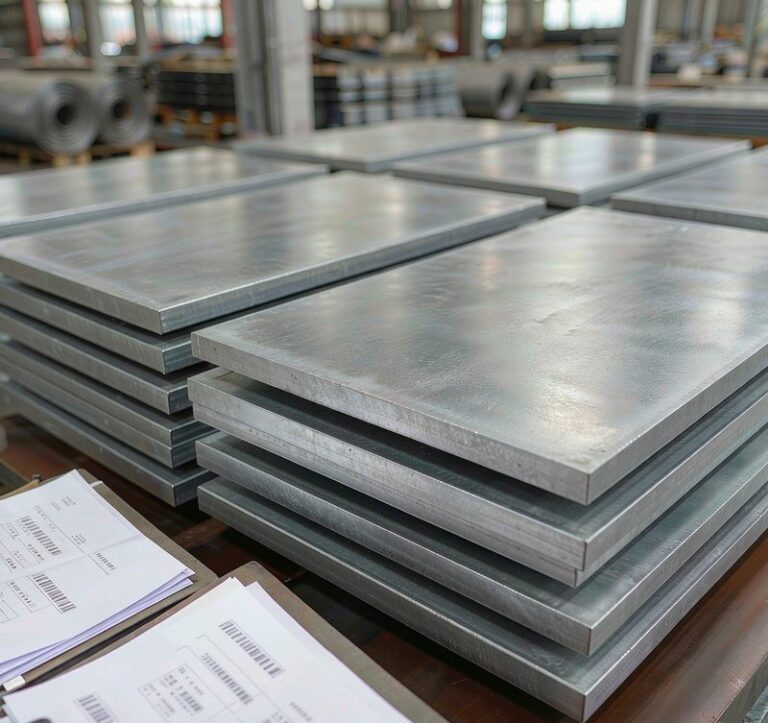
From plate stock at HXM’s Shanghai warehouse, ready to ship worldwide. Standard thicknesses from 3 mm to 12 mm in H32 and H116 tempers; both alloys share the same handling and packaging standards.
Need a 5454 or 5052 plate quote with EN 10204 3.1 cert?
Tell us the alloy, temper, thickness, width, and quantity. We will respond with a current FOB China / CFR / DAP price within 24 hours, including lead time, mill cert sample, and shipping options.
Frequently Asked Questions — 5454 vs 5052 Aluminum
What is the difference between 5454 and 5052 aluminum?
Both are non-heat-treatable Al-Mg-Mn alloys in the 5xxx series, but 5454 contains 0.50 – 1.0 % manganese versus 0.10 – 0.35 % in 5052. That extra Mn gives 5454 a finer grain, higher recrystallisation temperature, and roughly 20 – 30 MPa more strength at room temperature — and critically, about half the strength loss at 150 °C. 5052 is the cheaper, more widely stocked workhorse; 5454 is the hot-service upgrade chosen when welded vessels run above 65 °C. See our 5052 alloy guide for the chemistry walkthrough.
Is 5454 stronger than 5052?
Yes. At room temperature 5454-H32 yields roughly 240 MPa versus 160 MPa for 5052-H32 in equivalent plate thickness — about 10 – 15 % higher ultimate tensile strength and a meaningful gain in yield. The gap widens with temperature: at 150 °C, 5454-H32 still retains ~85 % of its room-temperature strength while 5052-H32 drops below 70 %. For pure room-temperature welded assemblies, the two are nearly interchangeable.
Which is better for pressure vessels?
For unfired pressure vessels governed by ASME BPVC Section VIII, 5454-H32 / H34 is the better choice. It carries higher allowable stress (78 – 85 MPa at 40 °C versus 65 – 70 MPa for 5052-H32 / H34) and is rated for service up to 200 °C. 5052 is acceptable for low-pressure, ambient-temperature vessels — but the moment you cross 100 °C or weld a hot-process jacket, 5454 becomes the safer and more economical long-term choice.
Which is better for road tankers?
5454 is the dominant alloy for ADR / IMDG road tankers transporting hot chemicals, hot bitumen, or food oils above 65 °C. 5052 is widely used for fuel tankers, milk tankers, and chemical tankers operating at ambient temperature — where its lower cost and wider product range (sheet, coil, tube, bar) pay off. If your tanker carries heated cargo, specify 5454-H32 or 5454-H116 shells with ER5183 / ER5556 filler and EN 10204 3.1 certification.
What is the maximum service temperature for 5052?
ASME BPVC Section VIII limits 5052-H32 / H34 to roughly 100 °C maximum, and in practice most fabricators derate 5052 service to 65 °C continuous because the weld heat-affected zone loses 30 – 40 % strength by 150 °C. For hot cargo or hot-jacketed service, switch to 5454-H32, which retains design strength up to 200 °C.
What is the maximum service temperature for 5454?
5454-H32 is rated for continuous service up to 150 °C and ASME BPVC-accepted up to 200 °C. Above 200 °C, both 5052 and 5454 enter the creep range and are unsuitable for pressure-retaining service. For temperatures beyond 200 °C, the next step up is 5083 (up to 65 °C only but higher strength) or a 6000-series alloy.
Which alloy has better weld strength?
5454 has the higher as-welded strength regardless of filler choice. With ER5183, 5454-H32 reaches ~235 MPa as-welded UTS versus ~210 MPa for 5052-H32 — a 12 % advantage. With ER5556, the gap widens to 245 – 260 MPa versus 215 – 230 MPa. The higher Mn in 5454 reduces HAZ softening because Mn-rich dispersoids slow grain growth during welding. Read our aluminum welding guide for filler selection detail.
Does 5454 meet ASME BPVC?
Yes. 5454-H32 and 5454-H34 are listed in ASME BPVC Section VIII, Table AL-2.1 for allowable-stress design. Allowable stresses at 40 °C are 78 MPa (H32) and 85 MPa (H34), with derated values at 100 / 150 / 200 °C as shown in the table earlier in this guide. For EN 13445 (European pressure vessel code), 5454 is also referenced in EN 13480-4 as a permitted material for non-fired pressure vessels.
What filler wire for 5454 welding?
Use ER5356 for general fabrication (good colour match, adequate strength). Use ER5183 for welded pressure vessels (matches 5454 chemistry, higher strength, better hot-service performance). ER5556 is the top choice for hot tankers and critical welds — highest as-welded strength but slight Cu content means it should be avoided in nitric acid service. ER4043 (Al-Si) is not recommended for 5454 — use 5xxx fillers only.
Can I substitute 5454 for 5052?
Yes in most cases — 5454 is generally a drop-in upgrade for 5052 because their densities (2.68 vs 2.69 g/cm³) and elastic moduli are nearly identical, and both weld with the same 5xxx filler family. The reverse substitution (5052 for 5454) is not safe in hot service above 65 °C or for BPVC pressure-vessel applications. Always revalidate the ASME allowable stress and confirm with your design engineer before swapping.
How much does 5454 cost vs 5052 in 2026?
5454 carries a 5 – 10 % price premium over 5052 in plate, sheet, and coil form, driven by tighter Mn control, lower production volumes, and longer mill lead times. As of mid-2026, indicative FOB China prices (3 – 8 mm plate, mill finish) are:
- 5052-H32: $2.80 – 3.10 / kg
- 5454-H32: $3.00 – 3.30 / kg
- 5052-H116: $3.10 – 3.40 / kg
- 5454-H116: $3.30 – 3.60 / kg
EN 10204 3.1 mill-cert adds $0.02 / kg regardless of alloy. For thinner coils and 1 mm sheet, the premium narrows because 5052 is far more widely stocked.
Does HXM supply both 5454 and 5052?
Yes — HXM Aluminum supplies both alloys in H32, H34, H111, and H116 tempers with EN 10204 3.1 certification. Standard thickness range is 1.0 – 12 mm for plate and 0.3 – 6 mm for coil, with custom widths up to 2,650 mm. MOQ is 1 – 3 tonnes and lead time is 15 – 25 days. We also supply 5052 sheets and plates, 5052 coils, and 5052 strips in cut-to-length and custom packaging.
Continue Your Research
Below are the related HXM guides that will help you complete the material specification:
- 5052 Aluminum Alloy Guide — chemistry, mechanical properties, tempers, and applications of 5052 in detail.
- 5052 vs 5083 Marine Aluminum Guide — when 5083-H116 / H321 is the right hull-plating alloy.
- 3003 vs 5052 Aluminum Guide — when 3003 is sufficient and when you should upgrade to 5052.
- 3003 Aluminum for HVAC & Heat Exchangers — fin-and-tube stock for heat-transfer equipment.
- Aluminum Welding Guide — Methods & Filler Metals — full ER5356 / ER5183 / ER5556 / ER4043 selection matrix.
- Aluminum Bending & Forming Guide — bend radii, springback, and tooling data.
- Aluminum Corrosion Resistance Guide — pitting, galvanic, SCC, and exfoliation ratings by alloy and environment.
- 5052 Sheets & Plates Product Page · 5052 Coils · 5052 Strips — current stock list and MOQ.
Source 5454-H32 and 5052-H32 plate from a single mill
HXM Aluminum ships 1 – 12 mm plate with EN 10204 3.1 cert from Shanghai / Tianjin / Qingdao to your port. MOQ 1 – 3 t, lead time 15 – 25 days, matched ER5183 / ER5556 filler coil on request.